Misquoting MLK not just a Republican problem

I’ve got to hand it to the GOP and a couple of centrist Democrats – they certainly know how to misinterpret and misrepresent the message of Dr. Martin Luther King Jr. in an effort to promote their retrograde agendas.

It never fails, almost like clockwork, some politician will echo (arrogantly and without shame) a select passage of the iconic speech that the late civil rights leader delivered during the March on Washington in 1963: “I have a dream that my four children will one day live in a nation where they will not be judged by the color of their skin, but by the content of their character.”

It was a profound comment to be sure. And, indeed, every morally requisite human being should adopt and unapologetically embrace its values. The problem is many members in the two aforementioned categories fail to “practice what they preach,” choosing instead to engage in antics that embody the antithesis of such traits.

The most recent is newly inaugurated Virginia Gov. Glenn Youngkin, who shamelessly employed all sorts of disturbing sorts of dog whistles in his gubernatorial campaign. Youngkin perversely used King’s words to advocate for parent’s choice in public schools, issuing an executive order to justify his ban on critical race theory in K-12 education.

“We must equip our teachers to teach our students the entirety of our history — both good and bad … Only then will we realize Dr. Martin Luther King Jr.’s dream that our children ‘will not be judged by the color of their skin but by the content of their character,’ ” Youngkin’s executive order states.

Several months earlier, it was Florida governor and much talked about potential 2024 Republican presidential candidate Ron DeSantis who incorrectly cited the civil rights leader. DeSantis stood before his state legislature with a straight face and declared that his reason for invoking his STOP W.O.K.E. Act, a law that grants parents permission to sue teachers caught teaching critical race theory in Florida public schools, was “to honor the spirit and values of Dr. Martin Luther King Jr.”

Yes, you read that correctly.

I wonder if King were alive today, would he have advocated to direct such hostility and disingenuous outrage toward any form of education that taught kids to learn about the history of its people regardless of whether the truth that emerged from such information turned out to be either good, bad or ugly? You can’t make this stuff up! This is political theater of the obscene.

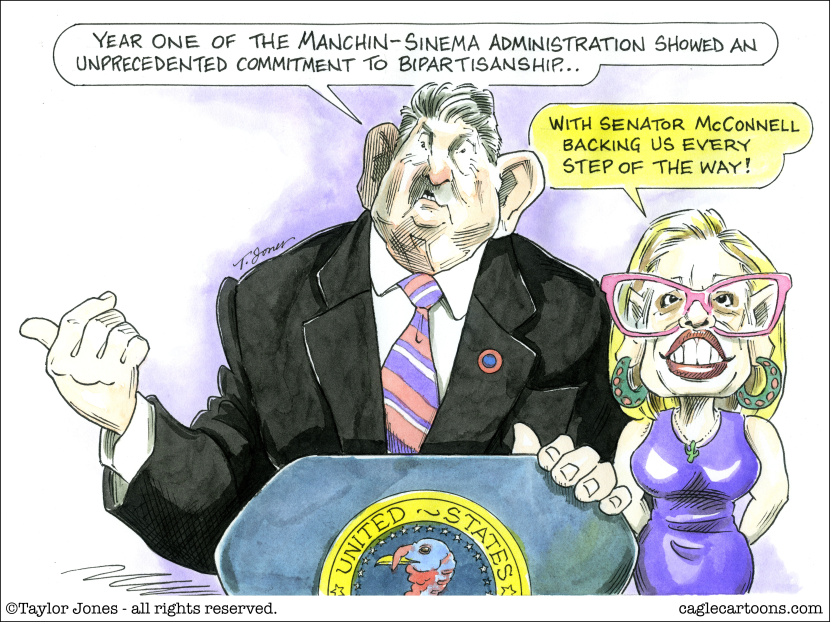
The gross misinterpretation of King’s message doesn’t end with Republicans — they have kindred spirits in the Democratic party who enjoy playing similar games. Arizona Sen. Kyrsten Sinema, who has pretty much thumbed her nose at every segment of the progressive wing of her party, stated that John Lewis, the late congressmen for who the voting rights bill is named, along with King were her personal heroes. Go figure.

Perhaps she feels that the most effective and laudatory way to support the legacy of both men is to politically align herself with Republican senators like Ted Cruz and Mitch McConnell to protect the filibuster (a long held relic of Jim Crow) rather than pass legislation designed to protect the right to vote for Black people.

It should not go without saying that in his landmark article “Letter From Birmingham Jail,” King made it clear that he reserved the majority of his frustration with the white moderate.

The truth is that most of Republican politicians would have likely mercilessly attacked King and everything he stood for tooth and nail had they been in congress during his time on Earth. He would have been lumped in with Black Lives Matter, a big government liberal, and referred to in other terms by this group of men and women to indicate their disdain for his progressive and humanitarian values.

The truth is King would have opposed virtually all the retrograde values these individuals embrace in his name.

Copyright 2022 Elwood Watson, distributed by Cagle Cartoons newspaper syndicate

Elwood Watson is a professor of history, Black studies, and gender and sexuality studies at East Tennessee State University. He is also an author and public speaker.

Comments Off on Misquoting MLK not just a Republican problem
The right to vote must be preserved

Last week, Arizona Sen. Kyrsten Sinema threw a wrench into Democrats’ plan on voting rights by continuing to oppose her own party’s efforts to reform the Senate filibuster.

She’s also undermining her party’s leader, President Joe Biden, who delivered a speech last week in Atlanta viewed by many as a turning point for his presidency. Accompanied by Vice President Kamala Harris, Biden delivered a fiery, passionate talk at Morehouse College declaring the urgency and necessity that Congress pass the Voting Rights Act.

To me, it wasn’t all that surprising that Biden chose Atlanta as the destination to deliver such a monumental address. The city served as the cradle of the modern civil rights movement, and is home to Martin Luther King Jr, Andrew Young, and many other civil rights leaders.

Much has been made of the fact that Biden made reference to racism and Jim Crow voting laws during his speech on voting rights, including this line:

“At consequential moments in history, they present a choice: Do you want to be the side—on the side of Dr. King or George Wallace? Do you want to be on the side of John Lewis or Bull Connor? Do you want to be on the side of Abraham Lincoln or Jefferson Davis?”

Some members of the audience gasped at such an analogy, according to reporters in attendance at the event. But Biden was spot on in his comparisons.

Eugene “Bull” Connor, George Wallace and Jefferson Davis were unapologetic racists (in the case of Wallace, he later repented) and adamant foes of the civil rights movement and racial equality in general. Indeed, the president spoke truth to power.

Who among us can forget the indelible memories of the horrific violence unleashed on March 7, 1965, better known as “Bloody Sunday.” when the late congressmen, John Lewis – for whom the bill is named — sustained a fractured skull as he and fellow protesters were beaten and gassed mercilessly by Alabama state troopers as they attempted to exercise their right to vote.

Later that evening, several television networks interrupted their regularly scheduled programming to inform the television viewing public of the chilling carnage that had occurred earlier that day in Selma, Alabama. Ironically, the ABC Sunday Night Movie that week was “Judgment at Nuremberg.”

Witnessing such a sadistic scene prompted rabid public outrage. Educational foundations, religious organizations, politicians, and private citizens from all walks of life flooded the White House with letters and telegrams demanding Congress move to ensure that American Negroes (the term used to refer to Black Americans in 1965) would not remained politically disenfranchised.

The intense public pressure culminated in Congress passing the Voting Rights Act, which was signed into law by President Lyndon Johnson on August 6, 1965.

That fact is that if it were not for tremendously brave people like John Lewis and others, it would have taken much longer for Blacks, particularly in the south, to gain those protections of the right to vote. Thus, millions of American southern Blacks would have continued to live under a system of detestable, political apartheid.

These were men and women of all races and ethnicities who embodied an undeniable and unmistakable level of courage, determination and dignity that made it possible for future generations to enjoy specific liberties that some of us have taken for granted Now voter suppression, and similar, sinister shenanigans taking place in a number of red states threaten nullify such freedoms.

Truth be told, numerous Black people (and others) who fought for voting rights in the early-to-mid 20th century endured routine death threats, foreclosure of property and poll taxes, oppressive sharecropping systems, entrenched legal discrimination, and numerous other forms of inhuman indignities on a daily basis due to race and skin color.

Too many Americans have lost their lives and endured far too much adversity in an effort to ensure that others would be granted the right to exercise their supposed constitutional rights at the ballot box. Thus, there is no other alternative than for voting rights to be upheld. Moreover, Black voters were the reason that Joe Biden and Kamala Harris reside in their current positions.

Black voters delivered for the Democrats during the last election. Now it is time for President Biden to reciprocate by passing the John Lewis Voting Rights Advancement Act and the Freedom to Vote Act by any means necessary. History demands he do so.

Copyright 2022 Elwood Watson, distributed by Cagle Cartoons newspaper syndicate

Elwood Watson is a professor of history, Black studies, and gender and sexuality studies at East Tennessee State University. He is also an author and public speaker.

Comments Off on The right to vote must be preserved

Sidney Poitier: Class, Wit, and Dignity

The incomparable Sidney Poitier departed this Earth last week, and it’s virtually impossible to detail the impact he had on both the film world and society in general.

When Poitier was awarded an honorary Oscar at the 2002 annual Academy Awards for his monumental contributions to the film industry, he reveled in such an honor with the signature refinement and sophistication that had been his hallmark since his initial foray into the Hollywood community.

He was the first Black person to be awarded the Academy Award for best actor in 1963 for his role as well—rounded handyman Homer Smith in the film “Lillies of the Field.” Poitier played itinerant jack-of-all-trades who stops at a farm in Arizona in the desert to obtain some water for his car. and ends up providing his carpentry skills to a group of nuns.

Poitier’s films are considered among some of the most distinguished ever made by Hollywood. He was one of the most prominent actors of the 1960s and became the number one box office star in America in 1967 with three smash box hits – “Guess Who’s Coming To Dinner?” “In The Heat of The Night” and “To Sir With Love.” Very few actors of any generation have achieved or accomplished such a level of notoriety.

Upon his death, the tributes were plentiful.”He was a gentle man and opened doors for all of us that had been closed for years,” fellow Academy Award winner Denzel Washington told the Hollywood Reporter. Hollywood mogul Tyler Perry wrote on social media the “grace and class that this man has shown throughout his entire life, the example he set for me, not only as a black man but as a human being will never be forgotten.”

“For me, the greatest of the ‘Great Trees’ has fallen,” Oprah Winfrey wrote, calling Poitier a “friend, brother, confidant” and “wisdom teacher.”

In the widespread reactions both in and out of Hollywood, there was no mistaking that the soulful, sophisticated, and revolutionary presence of a Hollywood giant had been silenced. For the most part, the films he starred in frequently delved into deeply controversial and intensely complex issues that usually eluded most other Black actors of his era.

Frank, fearless, forceful and without apology, Poitier deftly dissected the undeniable impositions, indignities and injustices that had and were still being perpetrated upon Black Americans and other people of color in his work. Without hesitation, he informed Americans about the abundant and bountiful history of people of African descent. In all aspects of his work, he demonstrated the routine resilience, pioneering spirit, and patience that has been an ongoing staple of American culture as it relates to its citizens of color, in particular, Black Americans.

In his movies, Poitier skillfully showcased the dignity and pride of the Black experience to the entire world. In particular, he told Black men they were handsome, intelligent, resilient and cultured, and did so with unmistakable and unapologetic candor. This was evident by the intelligence in which he chose his roles. He was very astute about the culture of the America he was performing for.

A number of his film choices garnered the ire of certain Blacks and more radical whites, who felt that he personified the image of a non-threatening, accommodating, “safe Negro.” The late film critic Pauline Kael wrote that “Sidney Poitier seems to always play the all American boy next door. Such an image is somewhat tiring.” In a more scathing acidic critique, New York Times film critic Clifford Mason wrote “He remains unreal, as he has for nearly two decades, playing essentially the same role, the antiseptic, one-dimensional hero.”

Critics aside, not even his more ardent detractors could deny Poitier’s undisputed power on the screen, no matter how subtle or blatant his acting was.

Race, class, religion, sexual politics and others dynamics have consistently roiled American society, and Poitier, with his keen precision and occasional humorous wit, fearlessly addressed such issues. Such pensive commentary prompted segments of American society to engage in some reflection and serious soul searching. Indeed, his demeanor was so sophisticated that many people eagerly followed his every move.

Sidney Poitier was one of a kind. His level of talent, intellect, insight, skill and other assets were undeniably admirable. The ample outpouring of admiration and respect he has received was well deserved. He was a legend during his time on Earth. He will be missed. May he rest in peace.

Copyright 2022 Elwood Watson, distributed by Cagle Cartoons newspaper syndicate

Elwood Watson is a professor of history, Black studies, and gender and sexuality studies at East Tennessee State University. He is also an author and public speaker.
Comments Off on Sidney Poitier: Class, Wit, and Dignity

Sadly, former Judge’s racial slurs are nothing new

Last week, a Lafayette, Louisiana judge resigned from her position after she and members of her family appeared to hurl vile racist slurs on camera.

A surveillance video showed people inside former city court judge Michelle Odinet’s home laughing and giggling, gleefully saying the N-word while watching security camera footage of a burglary attempt at her residence. While Odinet is never seen in the video, a woman’s voice believed to be hers repeats the racial slurs. “Like a roach,” the woman adds, laughing.

Footage from the incident, which occurred a few months earlier, was eventually uploaded to social media. As you’d expect, the public reaction was fierce, and the video led to an outcry from politicians, state officials and civil-rights groups in throughout the state.

Josh Guillory, the city’s mayor-president, made it clear that he was “disgusted and appalled” after watching the video, and the Lafayette Chapter of the National Association for the Advancement of Colored People demanded that Odinet submit her resignation. Governor John Bel Edwards and the National Bar Association echoed similar sentiments.

Not unlike many racists when caught red handed exposing their true behavior, the disgraced judge released the following statement to the public: “Anyone who knows me and my husband knows this is contrary to the way we live our lives. I am deeply sorry and ask for your forgiveness and understanding as my family and I deal with the emotional aftermath of this armed burglary.”

Not content to be quiet after being exposed for such embarrassing behavior, Odinet further claimed that her “mental state was fragile” following the alleged burglary, “I was given a sedative at the time of the video, I have zero recollection of the video and the disturbing language used during it.” Oh please, cry me a river. Or as the young folks say, “Bye Felicia!”

I guess she decided to take a page from Roseanne Barr, who in 2018, blamed Ambien for her racially offensive tirade against Valerie Jarrett, former President Barack Obama’s chief of staff. Barr was quickly terminate by then ABC President Channing Dungey. In a wickedly witty statement, a spokesperson for Ambien wrote in response to Barr’s remarks “racism is not a side effect of our medication.”

Odious antics aside, Olinet engaged in the most racially primitive language possible. Comparing Black people to apes, monkeys, animals and other less-than-human species is classic racist rhetoric straight out of the pages of regressive, old-fashioned, eugenic-minded, racial stereotypes. The entire issue is sickening.

One can wonder how many Black people who have come before her have been treated fairly. Indeed, the state may need to consider reopening any cases she has rendered judgment on as it relates to Black defendants.

The fact is that, since stepping foot on the shores of America, Black lives have been routinely scrutinized, objectified, sexualized and racialized. Many Black people — children as well as adults — have never been seen as fully human by their white counterparts. All too often, we have been seen as primitive, largely denied any degree of humane acknowledgment from mainstream society.

One has to ask: would the judge have reacted in similar, abhorrent fashion had the man who attempted to rob her home been white? I think we know the answer.

Most members of the judicial system are decent, law-abiding human beings who manage to admirably perform jobs that require judicial discretion and an abundant degree of conscientiousness. There also is a faction — one is too many — who are not as decent and shamelessly abuse their power.

White denial notwithstanding, Black people are human beings and deserve to be treated with as much respect and dignity as any other group of people. Such sadistic behavior and wicked disregard for people of color cannot continue.

Copyright 2022 Elwood Watson, distributed by Cagle Cartoons newspaper syndicate

Elwood Watson is a professor of history, Black studies, and gender and sexuality studies at East Tennessee State University. He is also an author and public speaker.
Comments Off on Sadly, former Judge’s racial slurs are nothing new

In Defense of the Miss America Pageant

2021 marked the centennial anniversary of the Miss America pageant. Perhaps it was only fitting that Emma Broyles, a 21-year-old college student from Anchorage became both the first contestant from Alaska and the first Korean American to win the national contest.

Broyles is currently a junior at Arizona State University where she is studying biomedical sciences and voice performance. In addition to the Miss America crown, she is the recipient of a $100,000 scholarship and a six-figure salary during her reign.

Like any prominent vehicle in the popular culture, the Miss America pageant has not been immune from criticism. It is an annual event that has been labeled as “sexist,” “retrograde,” “homophobic,” (yes homophobic), “kitschy,”” antiquated,” “elitist,” “draconian,” along with far more colorful terms that I cannot print here.

During its 100 years of existence, the pageant has managed to weather and overcome many crises and criticisms, including years of inactivity from 1929 to 1932, another cancellation in 1934, the Great Depression, World War II, charges of racism and sexism from feminist and civil rights groups in the 1960s and 70s, a gradual erosion in ratings, the Vanessa Williams /Penthouse magazine scandal in 1984, and periodic abandonment by mainstream network television.

While very few people would make the claim that all pageants are positive vehicles for women to showcase their talents and skills, it would be hard to make the case that Miss America is a negative representation for young women.

Unlike many other pageants, including its biggest rival, Miss USA, Miss America is holistic in its composition. Contestants participate in an intense interview session, are enrolled in college or are college graduates, and are required to have a personal platform that contestants advocate for during their year of service and beyond.

It is also important to note that, in the Miss America Pageant, contestants are of adult age and are participating in the competition by their own free will No one is forcing these young women to enter the contest.

We seem to impose a double standard, or should I say a paternalistic standard, on young women. If young men express their desire to participate in competitive or even potentially dangerous sports or other activities, we as a society have no qualms in encouraging them to “go for it.” After all, men should be assertive, aggressive and confident, right?

On the contrary, if a young lady decides to compete in a scholarship pageant, there are those naysayers who will do or say everything they can to discourage her, attempt to persuade her that she is being exploited, and that it could or will be psychologically and emotionally harmful to her self-esteem.

There is no doubt that many of the same critics who decried the swimsuit portion of the pageant when it existed (it was eliminated in 2018) had no problem tuning in to watch the Victoria Secret specials where models wear fashion attire far more modest than anything displayed in the pageant. These same individuals likely have no problem critiquing the bodies of young women (or men, for that matter), in magazines, on the internet or in other venues. Such blatant hypocrisy leaves much to be desired

The fact is that many Miss America pageant winners have been successful in their chosen fields, ranging from practicing law, writing, consulting, public speaking, media, and entertainment, to name a few. Recognizable winners include late Phyllis George, Vanessa Williams, Gretchen Carlson, Debbye Turner, Susan Perkins, Rebecca King, and Heather Renee French. The same holds true for many non-winners.

To be sure, there are millions of women who have enjoyed successful careers without entering a pageant, However, that was the decision they decided to make. The same reality holds true for the women who enter the Miss America pageant. They have made the choice to do so. More importantly, that choice is theirs, not yours or mine.

While there are many examples where one can point to women being exploited by society, the Miss America pageant is not one of them.

Copyright 2021 Elwood Watson, distributed by Cagle Cartoons newspaper syndicate

Elwood Watson is a professor of history, Black studies, and gender and sexuality studies at East Tennessee State University. He is also an author and public speaker.

Comments Off on In Defense of the Miss America Pageant

‘We Can’t Overstate Her Influence’: Remembering bell hooks

“I think we can’t overstate her influence.”

That’s a statement from Imani Perry, distinguished professor of Black Studies at Princeton University, who deftly and accurately summed up the impact of cultural critic Gloria Jean Watkins, better known to most of the world as bell hooks.

hooks, a revolutionary feminist voice, departed this Earth on December 15th at the age of 69. Predictably, the tributes were plentiful and largely laudatory for one of the most important voices in the field of women studies.

It’s virtually impossible to wholly detail the indescribable impact that hooks had on both the modern feminist movement and the larger literary world in general. As a professor who was introduced to her as an undergraduate student during my senior year, and became an avid fan, I can personally attest to this fact.

The author of more than 30 books and works of poetry, hooks’ work is required reading in many gender studies and humanities courses, and is a routine topic at academic conferences and feminist symposiums. She possessed razor sharp intellect, boundless passion and formidable intellectual acumen.

In contrast to many academics, she didn’t speak in didactic, convoluted language. Rather, she spoke in a manner that was powerful, competent, yet accessible

“Her writing is so powerful and so important, but it’s also so clear.” said Kikihana Miraya Ross, a professor of Black American studies at Northwestern University. “She has always been a role model for me in that way: no shade to people who don’t write like that, but I think that when you can say things clearly it means you understand what you’re saying.”

hooks was born on September 25, 1952 in Hopkinsville, Kentucky to a working class Black family. Her father, Veodis, was a janitor, and her mother, Rosa Bell, was a maid who worked in the homes of wealthy white families. Perhaps due to her hardscrabble life experience growing up in rural Kentucky during the era of Jim Crow segregation, hooks did not shy away from engaging in deeply controversial subjects some cultural critics (including some Black feminist writers) were apprehensive of venturing into.

Her critique of superstar Beyonce Knowles in 2016 — “Let’s take the image of this super rich, very powerful black female, and let’s use it in the service of imperialist, white supremacist, capitalist patriarchy, because she probably had very little control over that cover, that image” — sent ripples through the blogosphere and within feminist circles.

Frank, fearless, forceful and without apology, Hooks deftly and eloquently detailed the injustices still being perpetrated upon marginalized women of color due to sexism and misogyny. She eloquently told Black women that despite abject levels of societal marginalization due to centuries of disenfranchisement, they were beautiful, intelligent, and resilient, and worthy of love. She stressed the importance of self care.

“When we choose to love, we choose to move against fear, against alienation and separation. The choice to love is a choice to connect, to find ourselves in the other,” she wrote. “Love is a combination of care, commitment, knowledge, responsibility, respect and trust.”

Through it all, she expressed herself with formidable candor. Her bluntness garnered the ire of a number of critics, including Michelle Wallace and Adolph Reed. Detractors aside, even her most ardent critics could not deny her raw intellect and frequently innovative examination of intersectionality.

hooks was fearless discussing the internal conflicts that plague the Black community itself, which include class issues, religious preferences, sexism, and homophobia. Her occasional biting and humorous wit caused segments of the Black community to engage in some reflection and serious soul searching.

“Dominator culture has tried to keep us all afraid, to make us choose safety instead of risk, sameness instead of diversity,” hooks wrote in “Teaching Community: A Pedagogy of Hope.” “Moving through that fear, finding out what connects us, reveling in our differences; this is the process that brings us closer, that gives us a world of shared values, of meaningful community.”

bell hooks was a tremendous intellectual force. The ample outpouring of admiration and respect she has received is well deserved. Her work will undoubtedly be studied for decades, if not centuries to come. May she rest in peace.

Copyright 2021 Elwood Watson, distributed by Cagle Cartoons newspaper syndicate

Elwood Watson is a professor of history, Black studies, and gender and sexuality studies at East Tennessee State University. He is also an author and public speaker.

Comments Off on ‘We Can’t Overstate Her Influence’: Remembering bell hooks

Democracy Itself Is At Stake

“Democracy will be on trial in 2024.” That is one of the many startling revelations provided by Atlantic staff writer Barton Gellman in his new piece, “Trump’s Next Coup Has Already Begun.”

Gellman provides an extremely detailed analysis of how Donald Trump and the right-wing apparatus used the insurrection of the U.S. Capitol on Jan. 6 as a form of scrimmage to place further designs on grabbing and securing power in the near future.

To say it is an alarming and timely piece is to put it mildly. Just this week, we learned that Mark Meadows,, Trump’s former White House chief of staff, was pressured by Fox News hosts Sean Hannity, Brian Kilmeade, and Laura Ingraham to urge Trump to issue a statement calling for the rioters to cease their anarchic behavior. The president’s son, Donald Trump Jr,. was also among those privately pushing Meadows to force the president into action as the Capitol was being sacked.

There is no doubt we are residing in very unsettling times. Jan. 6 has quickly joined Dec. 7, 1941, Sept.11, 2001, and a few other dark days for our nation’s history, and will certainly reside in the tragic, horrific dustbin of infamy. The political atmosphere, while never totally serene, has become increasingly more frantic with searingly abrasive debates occurring at all levels of government.

Through it all, Republicans have continued to downplay the importance of the riots at the Capitol and the culpability of those who participated. Georgia Rep. Andrew S. Clyde referred to the insurrectionists who stormed the Capitol as “tourists,” while potential Speaker of the House Kevin McCarthy denounced the members who make up the Jan. 6th panel as a “sham committee”.

Republican Matt Gaetz, (who has his own problems to contend with) arrogantly stated at a Dec. 6 press conference, “We are going to take power after this next election and when we do, it’s not going to be the days of Paul Ryan and Trey Gowdy and no real oversight and no real subpoenas,” highlighting the District of Columbia’s jail conditions for accused U.S. Capitol rioters. “It’s going to be the days of Jim Jordan and Marjorie Taylor Greene and Dr. [Paul] Gosar and myself doing everything.”

Ever too eager to pacify their politically unhinged base with rancid, sour political rhetoric, certain right-wing pundits, such as Ingraham and Greg Kelly, have referred to members of the capital police who testified before the select committee as “crisis actors”, ”dishonest,” and “delusional.” Kurt Schlichter, a senior columnist for Townhall.com, called Officer Harry Dunn a “lying sack.”

Mark Twain once stated that “history does not exactly repeat itself, but it does rhyme.” There are a lot of eerily striking parallels between today and what occurred in our nation during the 1850s. Talk of secession. The Know Nothing Party. Rabid social and cultural distention. Indeed, the Republican Party of 2021 is tragically similar to the Democratic Party of the 1850s. Callous, arrogant, confrontational and prone to violence.

Back then, the primary issue of the era was slavery. Today, the dissension is divided across several issues, including immigration, race, abortion, sexuality, free speech, and religious freedom.

The current Republican Party has become so rapacious, barbarous and amoral in its blind thirst for power, they seem determined to attack and, if possible, overturn any election outcomes or social movements that are not conducive to their agenda. We have already seen the GOP engage in this sort of undemocratic activity with voter suppression and the duplicative election laws they have enacted.

Truth be told, Republicans made the decision decades ago to never alter their tactics in an effort to win over the votes of an ever-increasing non-white, racially diverse, left-leaning populace. Rather, they have decided to repress all entities whose ideology does not square with theirs.

The acrimonious rhetoric of the far right betrays the undeniable truth that they are terrified and aware that their stronghold on the current state of affairs will erode if they are unable to manipulate the laws and future elections. Thus, they are attempting to establish a form of minority rule. As President Biden and others have stated, such retrograde antics are a form of “Jim Crow 2.”

The present climate is filled with ample amounts of fear, resistance and anxiety. Things are tense to be sure. Such a situation certainly does not bode well for the immediate future.

Copyright 2021 Elwood Watson, distributed by Cagle Cartoons newspaper syndicate

Elwood Watson is a professor of history, Black studies, and gender and sexuality studies at East Tennessee State University. He is also an author and public speaker.

Comments Off on Democracy Itself Is At Stake

Critics Using the ‘Politically Correct’ Playbook on ‘Woke’

There are those of us old enough to remember when the term “politically correct” emerged into the public sphere. It didn’t take long for ideological culture warriors and politicians to exploit the term to suit their own agendas.

Now, almost three decades later, the term “woke” has become the adjective of the hour.

Like its verbal cousin, woke has been distorted by many on the right (and some on the left) who have perversely attempted to twist the term’s definition into something antithetical of its true meaning.

Merriam-Webster dictionary’s definition of woke is being “aware of and actively attentive to important facts and issues (especially issues of racial and social justice).” This very plausible and sensible definition makes sense to me. Nonetheless, we have seen the term repeatedly employed as a blunt instrument being hurled by bad faith actors, who often display a fierce and disturbing pride in not being mindful.

Critics are not confined to one side of the political spectrum. Individuals as diverse as far right MAGA Senators Ted Cruz and Marco Rubio, centrist Democratic strategist James Carivlle, and liberal comedian and cultural critic Bill Maher have all made their displeasure known. The ever irascible Cruz, has tweeted about “woke” Democrats, “woke” emasculated army soliders, “woke” CEO’s, and of course, the “woke” media. Mind you, this is the same man who picked a fight with Big Bird. Go figure.

Carville went so far as to denounce “stupid wokeness,” “faculty lounge talk” and “lunacy” as serious impediments to the Democratic party agenda, and chided wokeness as a major reason for Republican Glenn Youngkin’s victory in the Virginia gubernatorial race last month. Maher sees so-called woke ideology as “over dramatic, pessimistic rhetoric” whose “overriding thrust and ideology is that America is rotten to the core, irredeemably racist… oppressive, sexist, and homophobic.”

Yes! Indeed! Opinions are sharp and the passion has reached a fever pitch. For the record, as a college professor, I can say say it appears as though Carville has not spent that much time in college faculty lounges. The majority of professors do not ascribe to “the politics of wokeness”

In a 1962 New York Times op-ed titled “If You’re Woke You Dig It,” novelist William Melvin Kelley wrote about the appropriation of Black idioms by beatniks. During the civil rights movement, activists took the gospel song “Woke Up this Morning with My Mind on Jesus” and changed it to “Woke Up This Morning with My Mind on Freedom.”

Thus, the origins of woke, in this milieu – as fashioned by Black Americans – hearkens back decades to the early 1960s. But its conventional universality is a recent phenomenon. Due to the fierce trilogy of by Black musicians, social media and the Black Lives Matter movement, the term was included in the Oxford English Dictionary in 2017, defined as being astute to and sensitive to social issues.

If we are all being honest, woke politics is a bipartisan affair. Individuals across the political spectrum have aggressively utilized ill-defined indignities and manufactured outrage to launch and weaponize searing, bombastic rhetoric to score “points” against the other side. Wokeness is just a potent smoke screen to levy a political jaundiced eye against the perceived “other.”

The scorched earth antics that some proponents and critics of wokeness routinely engage in is a form of misguided aggression that cannot be condoned or tolerated in a society that prides itself on sane, rational and open debate of ideas. We should certainly remember to keep such sobering thoughts in mind. Period.

Copyright 2021 Elwood Watson, distributed by Cagle Cartoons newspaper syndicate

Elwood Watson is a professor of history, Black studies, and gender and sexuality studies at East Tennessee State University. He is also an author and public speaker.

Comments Off on Critics Using the ‘Politically Correct’ Playbook on ‘Woke’

Why Conservative Media Didn’t Latch on to the Ahmaud Arbery Case

More than a week has transpired since three Georgia men were convicted in the murder of Ahmaud Arbery.

It didn’t take long after the verdict was announced for pundits and legal experts to weigh in on the outcome of the trial, especially the role the predominately white jury played to bring justice in the killing of a young Black man.

“An almost all-white jury found these white defendants guilty of murder,” Page Pate, a Georgia lawyer, told NBC News. “It’s a good sign for our community and our country, and I think it says we support self-defense and the Second Amendment in the rural South, but when it’s upheld correctly.”

“He hadn’t committed a felony,” said Ira Robinson, co-director of the Criminal Justice Practice & Policy Institute and distinguished professor of Law at American University. “There was no citizen’s arrest, therefore, no self-defense. Instead, all there was was a totally unjustified murder as a result of vigilante justice,” Robbins said.

I have to confess I was more optimistic about the jury delivering a guilty verdict in this case than I was in the Kyle Rittenhouse trial. Turns out my hopes were well-founded, and justice prevailed and was served in the Arbery case.

While many were understandably pleased with the verdict, a large chunk of those on the political, social and cultural right were notably silent. The only exception were some far right-wing bloggers, like Christina Lalia at the conspiracy theory website The Gateway Pundit, who referred to Arbery as a “fake jogger.”

Fox News briefly alerted their viewers about the verdicts once they were announced, and quickly moved on to other news. Same held true for more reputable, mainstream conservative publications such as The National Review, Wall Street Journal, and others. To be honest, conservative media pundits never really lined up behind the men at the center of the Arbery trial as they had with Rittenhouse. There were probably a number of reasons for this.

Admittedly, while the Rittnehouse trial left open the argument for self defense as it related to the fracas that occurred that summer knight in Kenosha, the Arbery trial left no such degree of ambiguity. The video clearly depicted three crazed, unhinged vigilantes who took it upon themselves to chase, run down and aggressively shoot a young Black man who was simply out for a Sunday afternoon jog. Their racial profiling cost him his life. As a result, it would be difficult for all but the most hardcore bigot to justify such sadistic antics.

Moreover, the father-son duo of Gregory and Travis McMichael, along with their dastardly neighbor, William Bryan, were hardly telegenic. All three men looked unkempt, were overweight, had the charisma of a teaspoon and looked drably and dumpy. Remember when the defense attorney stated he wanted more “bubbas and Joe six packs” on the jury? The reason was obvious. These men epitomized such a less than stellar image.

On the contrary, Rittennhouse, with his preppy suits, well groomed, clean cut image (while he was on trial at least) was able to successfully play to the sensibilities of white conservatives, particularly those in higher tax brackets. When Rittenhouse broke down on the stand midway through the trial huffing, puffing, and gasping for air as tears poured down his clean shaven face, he came across to many of his supporters as someone who could easily be their son, nephew, or other relative.

Rittenhouse personified the boy next door who was being persecuted, making it easy for defenders to line up behind him, angered by their perception of an unjust situation. He became the poster boy for White empathy.

The defendants in the Arbery trial elicited no such level of empathy. They were viewed as menacing, overbearing, arrogant culprits who took it upon themselves to chase down a young Black man and act as judge, jury and executioner. They represented vigilantism at its worst.

Now that both trials have concluded, save for the sentencing phase of Arbery’s killers, the nation and media organizations have quickly shifted their focus on other matters. One thing is for certain – race remains an indisputable factor in America – past, present and almost certainly for the foreseeable future.

Copyright 2021 Elwood Watson, distributed by Cagle Cartoons newspaper syndicate

Elwood Watson is a professor of history, Black studies, and gender and sexuality studies at East Tennessee State University. He is also an author and public speaker.

Comments Off on Why Conservative Media Didn’t Latch on to the Ahmaud Arbery Case

Kyle Rittenhouse is the New Darling of the Right

Not guilty on all counts. That was the verdict rendered in the trial of Kyle Rittenhouse, the armed teenager who shot three people — killing two — during racial justice protests in Kenosha, Wisc. last year.

To be honest, I can’t say I was totally surprised. Witnessing the numerous acts of deference toward the defense by Judge Bruce E. Schroeder undoubtedly blew the judicial winds in Rittenhouse’s direction. He forbade the prosecution from calling the three men Rittenhouse shot “victims,” referring to it as a “loaded term.” The judges’ periodic outbursts at the prosecution team and his flippant remark about “bad Asian food being delivered on boats,” was hardly enlightening.

Predictably, critics across the political spectrum have wasted no time weighing in on the verdict and what they see as its potential ramifications.

Left-wing commentators, including MSNBC analyst Jason Johnson and The Nation columnist Elie Mystal, argue the verdict further emboldens right wing vigilantes, reassuring them that their wanton antics will result in little, if any, consequences for them. Conservative commentators, such as Tucker Carlson and Sean Hannity, celebrated the outcome, telling the nation and their followers that the jury understood Rittenhouse acted in self defense, and that the second amendment as it relates to the constitution still stands.

One thing’s certain: Rittenhouse has become a darling of the political, social and cultural right.

Paul Gosar, the politically unhinged, far-right Republican congressman, along with his equally seedy colleague Matt Gaetz, have talked of giving Rittenhouse a positions in their offices. Their politically ideological sidekick, Matthew Cawthorne, brazenly stated after the verdict on YouTube, “Kyle Rittenhouse is not guilty, my friends.”

Rittenhouse, with the aid of his mother, went to Kenosha in the wee hours of the morning with an AR-15 gun he was not licensed to carry. He needlessly injected himself into a dangerous situation and fatally shot two people, Anthony Huber and Joseph Rosenbaum, and almost killed a third person, Gaige Grosskreutz. While the panel of 12 jurors ultimately concluded that he exercised justifiable self defense, the truth is had he not taken it upon himself to engage in an act of vigilantism, he would never have found himself in such a position to begin with.

Most people realize there is virtually not a snowballs chance in hell that a non-white teenage boy would have been able to cross state lines armed with a deadly weapon they were not authorized to use, kill two protesters, then walk by an armed tank truck without being stopped by police. That kid would have been arrested on the spot, and its a good chance their parents would have been as well. Conservative commentator Charlie Sykes said it best: “If Kyle were black, he’d be dead.”

If there is anything good to come out of the trial, It was Rittenhouse telling Carlson in an interview Monday night he was a supporter of Black Lives Matter and that he acknowledged there are racial disparities in the criminal justice system.

Immediately following the verdict, there were those on social media arguing that race “had nothing to do with the trial” because all of the people involved were white. While all the central characters in the Rittenhouse saga were white — from the attorneys, to the judge, to the defendant, to most of the jurors — the fact is for many racially bigoted white people on the far right, those the join their non-white brothers and sisters to fight for social justice are often perceived as “aiding and abetting” the enemy. Race traitors so to speak. Thus, their lives and livelihoods are seen as unworthy of preservation as well.

To me, the most alarming result from this verdict is it emboldens a segment of racially-hyper white people to travel across the nation, armed to the teeth, and levy violence against any person they deem as a potential threat.

So many on the right are already neurotically paranoid about issues such as immigration, declining white populations, and what they see as their diminishing status in American society. This culturally volatile climate is ripe for disaster.

Copyright 2021 Elwood Watson, distributed by Cagle Cartoons newspaper syndicate

Elwood Watson is a professor of history, Black studies, and gender and sexuality studies at East Tennessee State University. He is also an author and public speaker.

Comments Off on Kyle Rittenhouse is the New Darling of the Right