Sonya Massey and the continued lynching of Black America

Violence and horror continue to haunt Black Americans.

Most Americans are likely to be aware of the horrific death of Sonya Massey at the hands of a sadistic police officer. Massey, a 36-year-old Illinois mother, had called 911 because she believed an intruder had entered her home. Two Sangamon County deputies arrived, and one of them, Sean Grayson, began spewing a tirade of profanity-laced threats during an argument over a pot of boiling water she was holding.

Grayson shot Massey at close range as she ducked behind a counter saying she was sorry. In fact, the first thing she said when the officers arrived at her residence was “please don’t hurt me.”

Bodycam footage revealed Grayson, a 30-year-old member of the force, ordered her to her kitchen to turn off a pot of boiling water. My heart almost froze and my ears cringed as I saw and heard him ruthlessly pump six bullets into her petite body. He murdered her as she was holding her pot.

Police department records revealed Grayson had a history of misconduct. Why he was not previously disciplined is disturbing. Grayson has been terminated and charged with first-degree murder. He’s a cold-blooded killer who should be prosecuted to the fullest extent of the law and never see the light of day again.

The truth is Sean Grayson is just a microcosm of the larger issue of violence against Black people. The death of Black Americans at the hands of law enforcement has become so commonplace and routine that many of us who are Black have managed to become simultaneously outraged and psychologically numbed. Over the past several years, we have become front row spectators to grainy and, in some cases, graphic footage of police officers engaged in horrific levels of violent behavior toward people of African descent.

The list is endless, including the names Tamir Rice, Ousmane Zongo, Rekia Boyd, Walter Scott, Eric Garner, Kajieme Powell, Breonna Taylor, George Floyd, and so, so many others. Unfortunately, we now have to include Sonya Massey among a list of victims that had deadly encounters with the people charged to protect them.

Massey’s son, Malachi, told reporters how much he loved his mother’s food and described her as a loving “ball of energy.” The comments were simultaneously heartwarming and heartbreaking.

Thankfully, Grayson’s defenders seem few and far between. But there are those on the fringe perversely defending his character, citing the fact Massey had a pot of hot water as justification for him to feel physically threatened. Let’s say for the sake of debate he did feel threatened. Did such fear give him permission to fatally pump several bullets into another human being while that person was unarmed? The entire issue is disgraceful.

The undeniable reality is that, since stepping foot on the shores of America, Black lives and bodies have been routinely scrutinized, objectified, sexualized, and racialized. For many in our society, Black people  have never been seen as fully human. All too often, we have been seen as men and women who are largely primitive and invisible, denied any degree of humane acknowledgment from mainstream society.

One has to ask whether the average White person is likely to be the victim of such random violence by police officers. The answer is absolutely not! The fact is that

If white people, particularly those in the middle and upper class, were routinely and randomly subjected to police violence and  gunned down in the street by law enforcement at the same rate as Black and Hispanic people, there would be calls for congressional hearings and massive demonstrations. Cries of protest would reverberate so loudly and fiercely it would be political suicide for any politician or police force that dared to ignore them. The same social outrage must become a reality for people of color as well.

These killings are modern day lynchings. Such sadistic behavior and wicked disregard for people of color cannot continue.

Copyright 2024 Elwood Watson, distributed by Cagle Cartoons newspaper syndicate

Elwood Watson is a professor of history, Black studies, and gender and sexuality studies at East Tennessee State University. He is also an author and public speaker.

Comments Off on Sonya Massey and the continued lynching of Black America

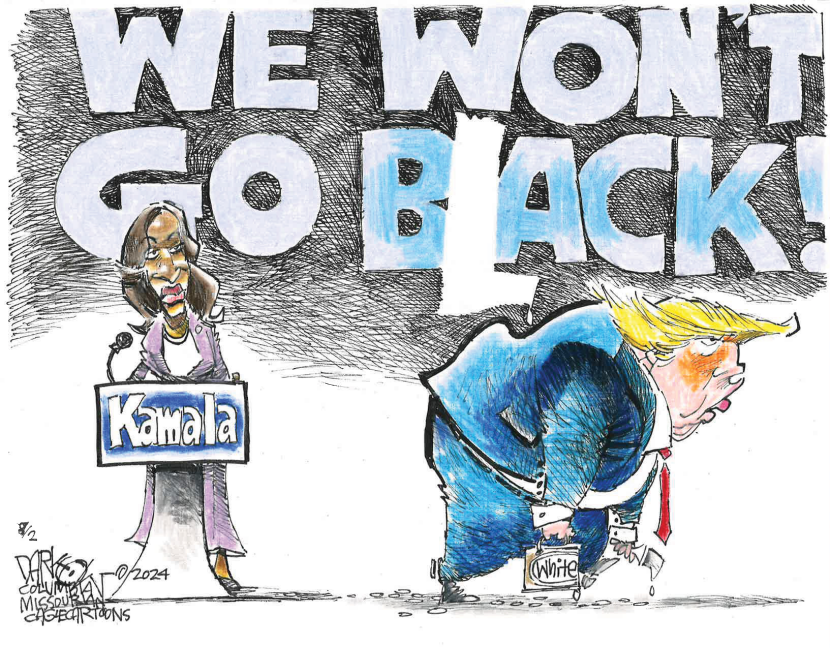
Kamala Harris is a mirror to the racist right

One would be hard-pressed to think of a vice president in recent memory placed under as much of a political microscope as Kamala Harris. She can hardly sneeze without someone, somewhere analyzing or dissecting her every move. And let’s not get started on how some of her critics attack her supposed “strange” laugh.

Some on the right have insinuated Harris slept her way to the top. Some, including Donald Trump, falsely claim she’s not really Black because her father is light-skinned and her mother was from India. The founder of Pastors for Trump, a group of supposedly Christian pastors, called Harris a “Ho.”

Shortly after Harris was sworn in as vice president, two white so-called Christian pastors derided her as a “Jezebel,” a term with a long, racist history. It symbolizes a return to America’s racist and misogynistic history of casting Black women as uncontrollably sexual, which served to grant slaveholders the license to sexually violate slave women. Though in terms of sheer politics, it’s probably not the wisest course of action for the Trump campaign to focus on any rival candidate’s relationship history.

Black women seeking the office of the presidency is not new. In 1972, Shirley Chisholm, the first Black woman elected to Congress in 1968, attended a Baptist church in New York City and declared her candidacy. Chisholm was a distinctive entity in American politics of the era. Her ardent support of civil rights and abortion rights demonstrated that was a crucial political bridge between the interests of Black Americans and the emerging, largely white, abortion-rights movement.

Although she was a pioneer, Chisholm’s campaign — pitted against a predominately white male field of candidates for the Democratic Party’s nomination — was seen as mostly symbolic and not taken seriously.

The Congressional Black Caucus, which was in its genesis stage at the time and of which Chisholm was also a founding member, declined to endorse her. Many of her fellow Black colleagues supported George McGovern, who became the eventual nominee. The reasons for doing so were political as well as pragmatic. As the caucus saw it (sad to say, correctly so at the time), the nation would not support a Black woman, and the more effective strategy would be to support a viable candidate.

Many Americans have never been comfortable with Black women in leadership positions. It is not accidental that we have only had two Black women elected to the U.S. Senate: Harris and Carol Mosley Braun of Illinois. Sen. Laphonza Butler was appointed by California Gov. Gavin Newsom to fill the seat left vacant by the death of Dianne Feinstein.

As a woman of color and a biracial one at that, Harris has to deal with the twin evils of “Jim Crow and Jane Crow.” The term was espoused by pioneering legal scholar Pauli Murray. The intersection of race and gender has undoubtedly contributed to much of the derision toward Harris from certain segments of society.

This reality of Harris as the first Black female nominee of a major party for president is an image that upsets the stomachs and emotions of a large number of right-wing Republicans, and, if we are being honest, a segment of neoliberal and faux Democrats as well. A Black woman being elected president before a white woman would likely be a tough pill for many to swallow and seemingly almost impossible for many whites across the political landscape to comprehend.

Harris remains immensely popular among Black women, the Democratic Party’s most dedicated voting bloc. Her fierce speeches at HBCUs, visits to Planned Parenthood clinics, and passionate speeches on reproductive rights have garnered her admiration among a growing number of people, in particular, younger millennials and Generation Z’ers.

Harriet Tubman, Elizabeth Freeman, Sojourner Truth, Ida B. Wells, Mary McCloud Bethune, Rosa Parks, Daisy Bates, Septima Clark, Coretta Scott King, Betty Shabazz, Barbara Jordan, Fannie Lou Hamer. One can only imagine what they and so many other faceless, nameless unsung Black women who fought for progress would think of the political events surrounding this current moment.

A Black, biracial woman who, in certain parts of the nation, was not even allowed to vote until 1965, is now poised to make history by possibly becoming the first female president of the United States. Progress, indeed.

Copyright 2024 Elwood Watson, distributed by Cagle Cartoons newspaper syndicate

Elwood Watson is a professor of history, Black studies, and gender and sexuality studies at East Tennessee State University. He is also an author and public speaker.
Comments Off on Kamala Harris is a mirror to the racist right

The worst VP pick

After all the speculation about whom he would choose, Donald Trump selected JD Vance, the junior senator of Ohio, as his running mate in the presidential race.

A former “public affairs” marine turned venture capitalist, Vance rose to fame in 2016 with the publication of “Hillbilly Elegy,” an engaging narrative that detailed his challenging and adversarial upbringing in poverty-stricken southwestern Ohio and his later experiences at Yale law school. The book became a national bestseller and the subject of the Ron Howard-directed 2020 film starring Glenn Close and Amy Adams.

In fact, I assigned the book for reading in one of my graduate seminars. What a difference a few years can seem to make.

Not that long ago, Vance was a vehement and outspoken Trump critic, deriding him as “America’s Hitler” and “a total fraud.” But he suddenly and abruptly embraced the former president when he ran for a Senate seat in 2022, eventually securing Trump’s support in a heavily crowded Republican primary. Indeed, both men acknowledged that they had not previously been politically fond of one another.

Presidents and vice presidents have frequently been odd pairings often brought together in an effort to unify diverse fragments within the party. John Kennedy selected Lyndon Johnson with the aim of assuaging southern Democrats who were wary of his Roman Catholicism and “possible allegiance” to the Vatican. Ronald Reagan chose George H. W. Bush, the former head of the CIA, in an attempt to win over centrist Republicans leery of Reagan voters’ far-right values. Barack Obama selected Joe Biden in 2008 to balance the ticket racially and reassure white voters that he’d have an experienced, centrist leader with blue-collar bona fides at his side. Trump recruited Mike Pence to address devout White evangelicals’ apprehensions over his moral failings and deficiencies. Most recently, Joe Biden selected a woman of color as his running mate to highlight and acknowledge the vital importance of women and people of color to the Democratic political base.

Trump had a real opportunity to make a more traditional choice. For a number of reasons, Florida Sen. Marco Rubio would have been a strong pick. As a Latino, he would have been the first non-white person on a Republican ticket and would possibly have appealed to Latinos who tend to be receptive to culturally conservative messages and may have cut into support from that segment of the Democratic coalition. The more centrist Republicans wanted Trump to assuage the apprehensions of more moderate voters who had backed Nikki Haley over Trump’s bombast and division.

He failed to deliver to both groups.

Rather than pretend to consider pacifying the concerns of his party’s more centrist, less rabid elements, Trump’s selection of Vance sends a clear and undeniable message that Republicans are waging a culture war over this nation’s identity. For example, in 2019 Vance told the National Conservatism Conference, “Our people aren’t having enough children to replace themselves. That should bother us.” Although he did not specifically define “us” or “our people,” and he did not elaborate what he meant by “replace,” it does not take a rocket scientist to realize that he did not conveniently employ words by sheer coincidence or accident. He knew exactly what he was saying and doing.

Racial matters aside, Vance also prolifically criticizes women. He  supports a national abortion ban and even opposes rape and incest exceptions — he calls rape “an inconvenience”— because, in his own words, “two wrongs don’t make a right.” He opposes no-fault divorce, which allows women to depart troubled marriages without having to prove abuse in court. Notably, Vance has a searing contempt for childless adults, particularly women, blaming the “childless left” as responsible for many of society’s political and cultural problems. More incredulously, Vance has proposed extending extra votes to people with children to dilute the political representation of those without them.

Even more disturbing about Vance is that he, like Trump, harbors no qualms about ruthlessly dismantling the delicate social fabric that supports the nation. He stated that if he had been vice president on January 6, 2021, he would have adhered to Trump’s request and blocked electors from states that voted for Biden. He raised money for insurrectionists who tried to overthrow the government and sought to prohibit the ratification of an election in which all fifty governors  —  Republican and Democratic alike  —  certified results that showed Biden won the presidency.

Does this sound like someone who believes in law and order and due process? Is there anything Vance sincerely believes?

It’s a question many people, including myself, have been asking. The answers appear to be blind ambition, self-advancement, and power.

Copyright 2024 Elwood Watson, distributed by Cagle Cartoons newspaper syndicate

Elwood Watson is a professor of history, Black studies, and gender and sexuality studies at East Tennessee State University. He is also an author and public speaker.
Comments Off on The worst VP pick

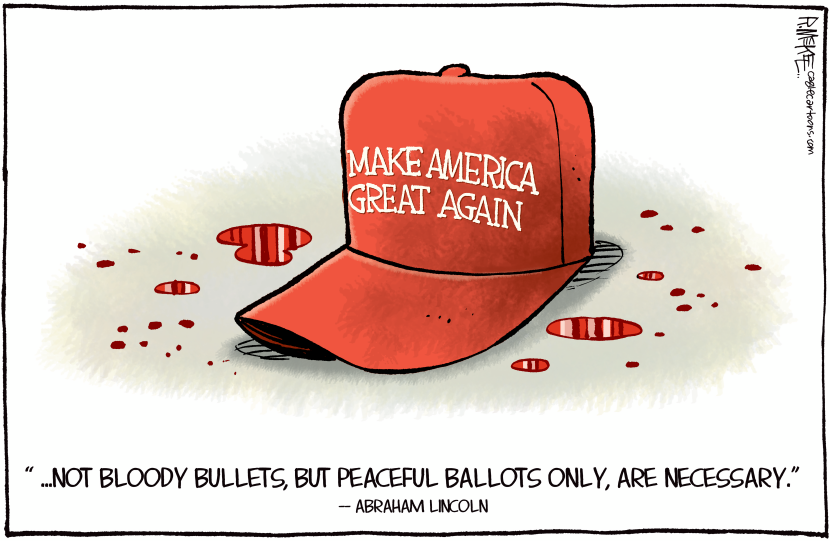
We’re at a crossroads following Trump assassination attempt

The political world was shaken over the weekend by the attempted assassination of former President Donald Trump.

Footage from the event showed Trump clutch his right ear and go down after gunshots rang out. Quickly rising to his feet amid a phalanx of U.S. Secret Service agents, Trump pumped a fist at the crowd as blood seeped from the side of his head. The agents responded swiftly to protect the former president and shot the apparent attacker, a registered Republican, to death.

From the outset, both Democrat and Republican leaders denounced the attack. President Biden said in a statement he was “grateful to hear that [Trump’s] safe and doing well. I’m praying for him and his family and for all those who were at the rally.”

I think it’s fair to say that most of us, regardless of our political perspectives, are grateful the former president survived such a horrific incident. Thankfully Trump escaped the apparent attempt on his life with only minor injuries.

However, it did not take long for partisan politics to emerge. Several Republican politicians, among them Republican Vice Presidential nominee, J. D. Vance, South Carolina Sen. Tim Scott, and Congresspeople Marjorie Taylor Greene and Steve Scalise blamed the far left and liberal media for demonizing Trump.

Georgia Rep. Mike Collins went so far as to state Biden “sent the orders” for the shooting and urged the local prosecutor to file charges against the president “for inciting an assassination.” Mind you, this same Collins once ran a campaign ad in which he fired a rifle at former House speaker Nancy Pelosi and created a cardboard box of supposedly RINO Republicans.

Accordingly, there were those on the left who wasted no time in taking to social media to make dubious assumptions, posting their own “false flag” conspiracies. The now-famous photo of Trump surrounded by Secret Service agents, pumping his fist with small streaks of blood across his face, was too clear and good not to have been staged, certain people argued. Dmitri Mehlhorn, a prominent Democratic strategist, emailed journalists encouraging them to consider the possibility that the conservative right staged the shooting to bolster Trump. After intense criticism, he apologized for his remarks.

Horrendous as it was, it’s not the first time someone has shot at a president or leading presidential candidate. Lone gunmen shot dead Abraham Lincoln, James A. Garfield, William McKinley, John F. Kennedy, Dr. Martin Luther King Jr., and Robert Kennedy. Back in 1912, former president Teddy Roosevelt, campaigning for a political comeback, took a bullet in the chest area, and other shooters failed to murder President-elect Franklin D. Roosevelt and President Gerald R. Ford.

In 1972, Arthur Bremer, a man searching for fame, shot Gov. George C. Wallace (D-AL) at a campaign event during his presidential run. John Hinckley attacked Ronald Reagan out of a deranged obsession to impress actress Jodie Foster. Such violence has deep historical roots.

The truth is Trump has adamantly engaged in the acerbic language of political violence for several years, demonizing his political enemies and ratcheting up partisan tensions to a frenzy. During his high-pitched fever rallies in 2016, he encouraged his supporters to chant that Hillary Clinton should be locked up. In June 2017, then-President Trump stated there were “very fine people” among the neo-Nazi marchers in Charlottesville.

He mused about considering strategies to shoot would-be immigrants in the legs or feed them to alligators as they tried to cross the southern border into the United States. Trump also advocated for the execution of Mark Milley, the former chairman of the Joint Chiefs of Staff, and just recently reposted social media calls for televised military tribunals to be held for members of the House Committee that investigated the January 6 insurrection.

Donald Trump’s attempted assassination may stir up political division and animosity even further. Alternatively, it could serve as a reflection point for serious, direct, impassioned yet civil and thoughtful debate. Let’s hope that it is the latter. Donald

By surviving the would-be assassin’s bullet, Trump spared the nation a collective bullet and another presidential tragedy.

Copyright 2024 Elwood Watson, distributed by Cagle Cartoons newspaper syndicate

Elwood Watson is a professor of history, Black studies, and gender and sexuality studies at East Tennessee State University. He is also an author and public speaker.
Comments Off on We’re at a crossroads following Trump assassination attempt

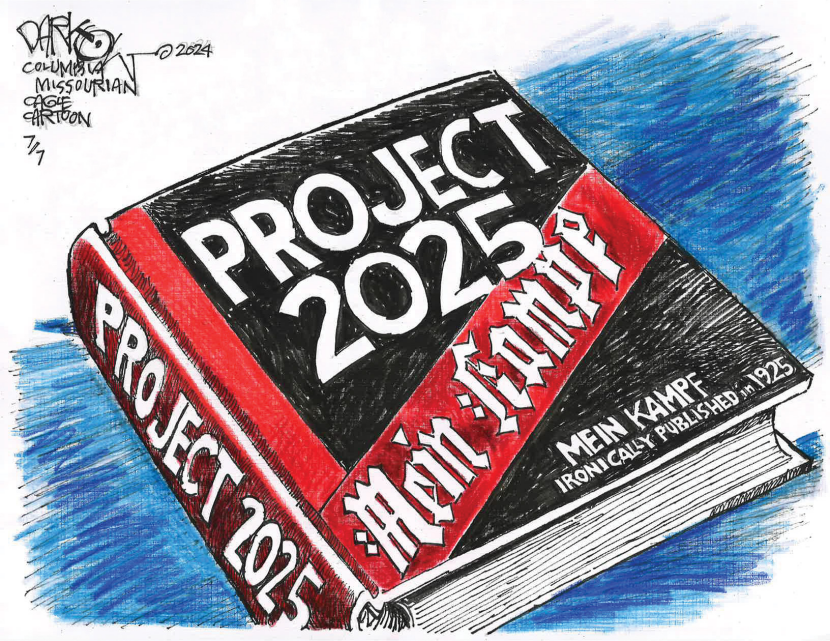
Democracy is on the ballot, thanks to Project 2025

Last week, Professor Ruth Ben-Ghiat , author of “Strongmen: Mussolini to the Present,” commented that “one of the most alarming things” about “Project 2025” is the blatant admission that Donald Trump did not accomplish everything he intended to in his first administration.

“They got a slow start […] so their codeword is ‘day one,’” Ben-Ghiat told MSNBC’s Katie Phang of the think-tank’s proposal document, which is assumed to represent a considerable percentage of a Trump’s policies should he be successful in earning a second term. “Already, politically vetted people are in place and will immediately implement the plans if Trump wins.”

Earlier this year, I wrote a column mentioning Project 2025 and the alarming agenda it intends to enact. Fortunately, it appears more Americans have become aware of this treatise,  an almost 900-page document vowing to rework every department, agency, and office within the executive branch if Trump returns to the White House.

Project 2025 has four agendas to advance conservative influence throughout the government, starting with a long roadmap. Alongside the document, the organization is developing a database of possible staff for an incoming Trump administration and, as part of a “Presidential Administration Academy,” is teaching new hires about how the government should function.

The penultimate step consists of a presidential transition playbook that seeks to help the next president hit the ground running in his effort to gain total control over the executive branch.

The intended actions of the organization includes redefining the way society functions, dismantling the social safety net, cutting wages for working people, undermining our economy, and reversing decades of civil rights progress.

Predictably, Donald Trump claimed to “know nothing” about Project 2025 or who authored it. Anyone that believes Trump is as gullible as they come.

Not surprisingly, many conservative organizations are behind the effort. Part of the plan includes terminating federal employees that conservatives believe are prohibiting right-wing policies from being implemented and replacing them with their own choices, as several news outlets have reported . The handbook describes “a top-to-bottom overhaul” of the Department of Justice and puts an end to the FBI’s efforts to curb the spread of misinformation. The handbook also said “the FBI have absolutely no business policing speech.”

Reproductive rights are also targeted. The plan wants the Centers for Disease Control and Prevention to cease promoting abortion as health care and urges the Federal Drug Administration to stop promoting and approving requests for creating abortion pills, referring to them as “the single greatest threat to unborn children in a post-Roe world.”

Not surprisingly, anti-LGBTQ+ and anti-diversity policies are also mentioned throughout the education recommendations sections in Project 2025 and in Trump’s platform. The project proposes ridding education programs of any “gender ideology and critical race theory,” such as a “non-binary” category in data collection or the ability of trans youth to participate in sports aligned with their gender. It also calls for parental approval for the use of names or pronouns other than those on their children’s birth certificates. And it wants to abolish protections against discrimination based on sexual orientation and gender identity.

The mandate targets anything the project considers to be “critical race theory.” Notably, these include “mandatory affinity groups,” training programs for teachers that require them to “confess their privilege,” and assignments in which “students must defend the false idea that America is systemically racist.”

Many other critics besides Ben-Ghiat have labeled Project 2025 as “authoritarian.” In fact, Kevin Roberts, president of the Heritage Foundation stated the project’s mandate “would be implemented smoothly without bloodshed, if liberals and progressives do not challenge it.” Really?! Talk about arrogance unbridled arrogance!,

To paraphrase renowned legal attorney Sherrilynn Ifill, former head of the NAACP legal defense fund and more recently, the Vernon E. Jordan, Jr., Esq. Endowed Chair in Civil Rights at Howard University. “If Mr. Roberts and his band of right wing acolytes believe that most American women , people of color, LGBTQIA+ and other historically marginalized groups are going to passively stand by and allow their hard earned rights to be revoked by a band of a right wingers with a fascist agenda, they have another thing coming!”

The language in Project 2025 presents an unmistakably ominous, threatening, declarative and dangerous agenda. It is an alarming ultimatum that must be taken very, very seriously. Democracy is on the ballot!

Copyright 2024 Elwood Watson, distributed by Cagle Cartoons newspaper syndicate

Elwood Watson is a professor of history, Black studies, and gender and sexuality studies at East Tennessee State University. He is also an author and public speaker.
Comments Off on Democracy is on the ballot, thanks to Project 2025

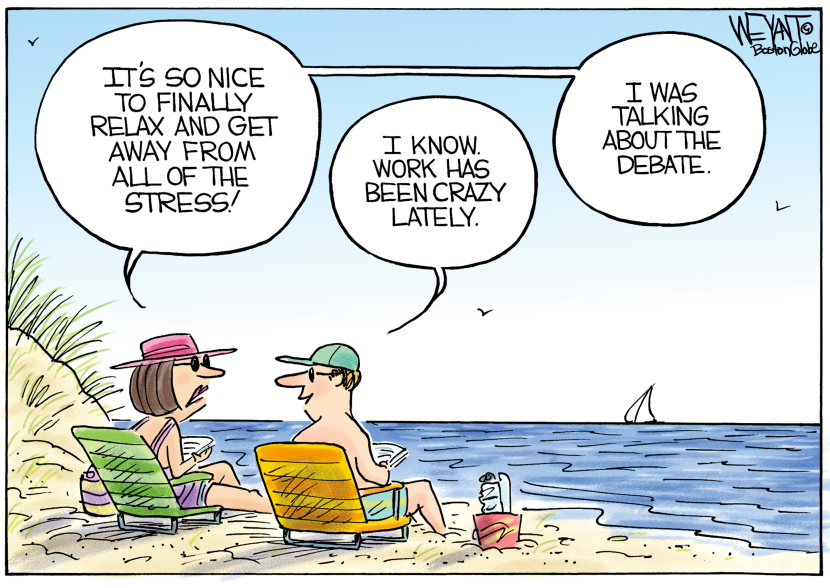
Biden remains the better choice in the election

When it comes to the issue of debates, perception is often just as crucial as reality and substance.

There is no way to codify the fact that Joe Biden’s debate performance last week was nothing short of dismal. The ferocity we witnessed at his State of the Union earlier this year was absent, although his performance did incrementally improve as the evening progressed.

The debate was an opportunity for Biden to ask the American people about what direction they wanted the nation to go: an optimistic future or a dystopian one. Unfortunately, on both counts, the president failed to deliver.

That said, former President Trump had a poor night as well. Admittedly, in contrast to Biden, he began the evening strong, but as the debate continued, he appeared and sounded more incoherent. Every answer he gave contained a considerable degree of lying. Even more disturbingly, he steadfastly refused to state he would abide by the results of the 2024 election. True to his character, he was abrupt, combative, and ruthlessly negative. As Trump sees it, the nation is a few steps away from implosion.

Trump’s positions on anything and everything shift and slide at will, and he lies about his own past with pathological confidence — during the debate, he denied that he had sex with Stormy Daniels while alternatively praising the white supremacists who emerged on Charlottesville in June 2017. He ignored questions and talked about what he wanted to — asked about the opiate crisis, he resorted to stories about sex crimes, out-of-control borders, immigrants taking “Black and Hispanic jobs,” and other dishonest nonsense.

In an effort to reassure some demoralized supporters, the president delivered an energetic speech in North Carolina the day after the debate, where he candidly confessed “I don’t walk as easily as I used to, I don’t speak as smoothly as I used to, I don’t debate as well as I used to.”

He went on, “But I know what I do know. I know how to tell the truth. I know right from wrong. I know how to do this job,” to rousing applause.

Prominent Democratic operatives such as Barack Obama, Bill and Hillary Clinton, and the Democratic National Committee have made it clear that they stand behind the president amid nervous calls for him to drop out of the race. It is interesting to note that many of the mainstream press, save for the Philadelphia Inquirer and a small number of pundits, did not suggest that President Trump resign, despite the fact that he is a convicted felon, sexual harasser, insurrectionist etc… Double standards seem to abound when it comes to critiquing both men.

The importance of presidential debates themselves is, in fact, up for debate. Many credit John F. Kennedy’s narrow victory in November 1960 with the fact he looked more appealing and telegenic than Richard Nixon. Some believe Gerald Ford may have forfeited the 1976 election when he mishandled a question about Soviet military strength in Eastern Europe. An ill-advised decision to keep looking at his watch became a memorable footnote in President George H.W. Bush’s defeat against Bill Clinton in 1992.

A first debate does not always guarantee a final outcome. Ronald Reagan in 1984, Barack Obama in 2012, and Grover Cleveland during his first presidency in 1884 (he was elected twice) were seen as the underdogs after their initial debate performances, yet went on to win their elections decisively.

It is troubling the Republican Party has refused to deeply consider the type of person it has decided to support as its party nominee. Trump’s own behavior, past and present, should be grounds for disqualification. He lied brazenly and repeatedly about his own actions, his record as president, and President Biden. The Republican Party has been sabotaged by Trump’s ambitions. Thus, it is up to the nation’s voters to decide whether they will place the interests of the nation above the ambitions of an unhinged, immoral man.

Joseph Biden was the first vice president to serve under a president of color. He is the first president to serve with a Black vice president, and the only president to serve with a female vice president. In a nation that historically has been deeply politically ingrained in racial conflict, such a fact itself is glaringly noteworthy. Regardless of whether Biden remains the Democratic nominee, this is a fact that will be permanently etched as a part of his administration’s history and presidential legacy.

Copyright 2024 Elwood Watson, distributed by Cagle Cartoons newspaper syndicate

Elwood Watson is a professor of history, Black studies, and gender and sexuality studies at East Tennessee State University. He is also an author and public speaker.
Comments Off on Biden remains the better choice in the election

The Ten Commandments and the creep of Christian nationalism

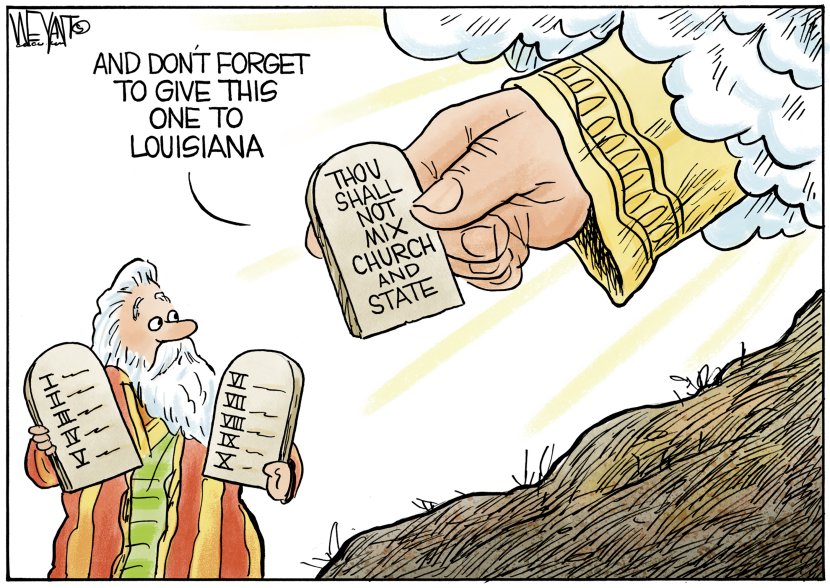
Louisiana Gov. Jeff Landry was brimming with pride and arrogance last week when he signed into law a requirement that every classroom in his state — from kindergarten to college chemistry labs — will be required to display a copy of the Ten Commandments.

“I can’t wait to be sued,” Landry said before signing the bill.

While other states have proposed similar bills, no one besides Louisiana has been successful enacting such efforts, especially with the threat of legal battles looming overhead.

Legal battles over the display of the Ten Commandments in the nation’s classrooms are not a new phenomenon. In Stone v. Graham in 1980, the Supreme Court struck down a Kentucky law that required the posting of the Ten Commandments, purchased through private donations, in every public school classroom in the state.

Landry didn’t stop there with his bravado. He also told the guests that, “If you want to respect the rule of law, you’ve got to start from the original lawgiver, which was Moses.” So by “respecting the law,” he meant defying it.

Not surprisingly, lawyers filed a flurry of lawsuits soon after the Republican governor ratified the bill.

The American Civil Liberties Union and other groups said the law violates both long standing Supreme Court precedent and the First Amendment, and would result in “unconstitutional religious coercion of students.” “Our public schools are not Sunday schools,” the organizations said in a statement, “and students of all faiths, or no faith, should feel welcome in them.”

Incidentally, in 2022, a group of right-wing writers and leaders published a document titled “Conservatism: A Statement of Principles.” The section on God and public religion stated, “Where a Christian majority exists, public life should be rooted in Christianity and its moral vision, which should be honored by the state and other institutions both public and private.”

That is an alarming and troubling statement, implying non-Christians should have second-class status in our country and that Muslims, Jews, Hindus, Buddhists, atheists, agnostics, and others should not be equal under the law. Such rhetoric is the antithesis of freedom to worship enshrined in the constitution.

Christian nationalism is not an ideology where an individual’s belief system defines their political values. Human beings can certainly hold divergent opinions on immigration, reproductive rights, or any other political issue. Like everyone else, Christians routinely spar among one another on such issues. Debate and diverse viewpoints are often beneficial to both the debaters and larger society.

Mandating that the Ten Commandments be displayed in every aspect of education in Louisiana or any state is largely an exercise in cynicism. Does any reasonable person believe that the average 4th grader is going to view such a document and state “Gee, I probably should not commit adultery anymore.” Please. A larger political agenda is at play here.

What distinguishes Christian nationalism is not religious participation in politics but the myopic perception that Christian primacy and theology must saturate virtually every aspect of our society. It embraces the visceral belief that the church’s well-being and survival relate to the outcome of any given political race. Christian nationalism’s supporters have little, if any, compunction about attempting to impose their personal value system upon others. This view often manifests through linear ideology, a specific identity, and unbridled passion. If such a regressive theocracy were successful in becoming the norm, it would abolish our current Constitution and further fragment our democracy.

Christian nationalists believe that only they are real Americans, and that the Constitution’s advantages and benefits apply only to them and those who share the same racial identity, religion, sexual and political orientation. Thus, racism and nativism deeply infest a segment of the movement.

Proponents of the passage of the recent Louisiana law have referred to the 2022 Supreme Court decision in Kennedy v. Bremerton School District, which reinstated a high school football coach after he was disciplined over a religious incident. The Supreme Court ruled that the coach’s prayers were indicative of private speech protected by the First Amendment, and the school district could not prohibit it.

What we can decipher is that right-wing politicians eager to make political inroads into the GOP’s conservative Christian base is an effective way to augment political support, gain political credibility, and line their coffers.

When Governor Landry stated, “I can’t wait to be sued,” perhaps he was thinking about the Republican Party’s current state of mind and the Supreme Court’s current political appetite. Come to think of it, he might have ample reason to feel deliriously giddy and optimistic. Let’s hope not.

Copyright 2024 Elwood Watson, distributed by Cagle Cartoons newspaper syndicate

Elwood Watson is a professor of history, Black studies, and gender and sexuality studies at East Tennessee State University. He is also an author and public speaker.

Comments Off on The Ten Commandments and the creep of Christian nationalism

The fight doesn’t end with celebrating Juneteenth

Here we are. Another year, another June and the nation is celebrating another Juneteenth holiday.

On June 17, 2021, President Biden signed the bill into law making Juneteenth the 11th holiday recognized by the federal government. At a White House ceremony, Biden singled out Opal Lee, an activist who at the age of 89 walked from her home in Fort Worth to Washington, D.C., and called her “a grandmother of the movement to make Juneteenth a federal holiday.”

On June 19, 1865, about two months after Confederate general Robert E. Lee surrendered at Appomattox, Va., Gordon Granger, a Union general, arrived in Galveston, Texas, to inform enslaved African Americans of their freedom and that the Civil War had ended. General Granger’s announcement put into effect the Emancipation Proclamation, which had been issued more than two and a half years earlier, on Jan. 1, 1863, by President Abraham Lincoln.

As is the case with Black History Month and other events associated with people of African descent, we are rightly introduced to and reminded of the innumerable contributions Black people have made to this nation. Corporations make bold and brazen acknowledgments, various institutions and churches salute Black history, sponsor dinners representing a culinary smorgasbord undeniably definitive of recipes that originated in the African diaspora.

Such broad acknowledgment is commendable. Black people have a complex and vibrant history vastly distinct from other ethnic groups due to the religious, economic, social, psychological and educational experiences that have been visited and inflicted upon us.

By exploring and acknowledging Black history, the nation is paying homage to a group of men and women who are strong, resilient, innovative, forgiving (in some cases, arguably too forgiving) and have contributed immensely to the vitality and success of the United States – a nation where some people never intended for us to obtain full citizenship or be fully included within the panorama of American culture.

Racism has always been an intractable part of this nation. It is deeply ingrained in the fabric of our culture and is as American as apple pie. What we have witnessed over the past several years is blatant, undisguised bigotry – the type that many racist white people had to keep disguised and leashed since the 1950s – now being allowed to unapologetically permeate various sectors of our society, in many cases without consequences.

We have brazenly right-wing politicians who routinely stoke the flames of racial and cultural animosity and division to appeal to their rabid, reactionary base. The time is ripe for a reinforcement of Black excellence to combat such racial resistance.

Since the time of this nation’s inception, Black Americans have had to wage a historically long battle, fighting to obtain rights that were supposed to be guaranteed by our constitution – rights most other groups have taken for granted. The mountains and minefields that our ancestors had to face head-on and triumph over are a testament to their impervious strength and spirit.

We are enduring similar battles today in the 21st century. Being Black in America often means waging an ongoing battle. We are seeing this with attacks on DEI, affirmative action, voting rights and other issues that are of crucial significance to the Black community.

While Juneteenth is an event that deserves to be part of the American holiday landscape, the fact is that a once per year celebration of a holiday aligned with the Black experience is not sufficient to compensate for the plethora of injustices that routinely affect many Black communities in our nation. The political, social, economic and cultural dilemmas facing Black America are problems that are endemic and deserve full and undivided attention.

Copyright 2024 Elwood Watson, distributed by Cagle Cartoons newspaper syndicate

Elwood Watson is a professor of history, Black studies, and gender and sexuality studies at East Tennessee State University. He is also an author and public speaker.
Comments Off on The fight doesn’t end with celebrating Juneteenth

Black Republican doesn’t know his Black history

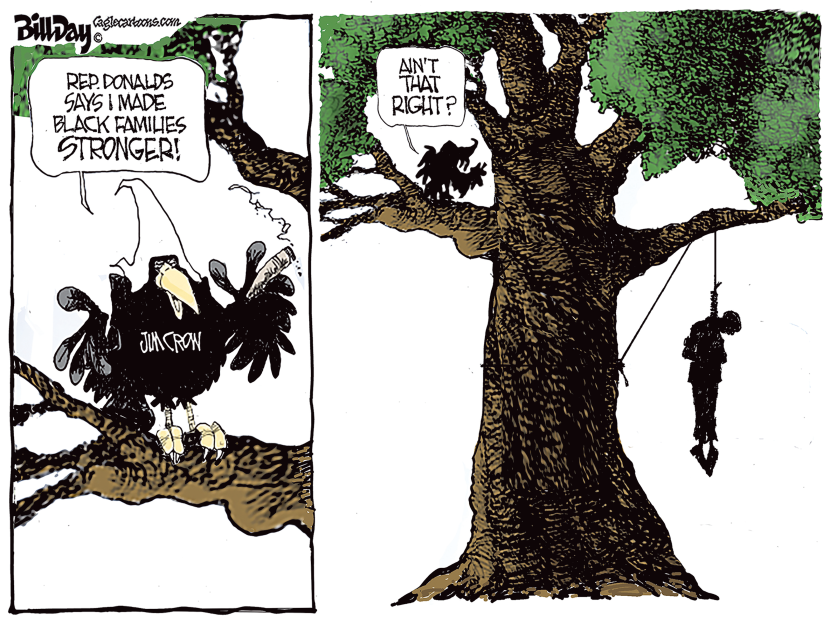
Earlier this month, during an event in Philadelphia supporting Donald Trump and the Republican Party, Florida Representative Byron Donalds made the attention-grabbing assertion that Black families were stronger and more conservative under the Jim Crow era.

“You see, during Jim Crow, the Black family was together,” Donalds said. “During Jim Crow, more Black people were not just conservative — because Black people have always been conservative-minded — but more Black people voted conservatively.”

Huh?

His commentary was challenged by New York Representative Hakeem Jeffries, the House minority leader, who called Donalds’ remarks “factually inaccurate.” The Democratic National Committee said it was “absurd to suggest” the Jim Crow era “was anything but a horrific stain on our country’s history.” The NAACP’s president, Derrick Johnson, said during an interview on CNN that Donalds was attempting to “self-benefit using a false narrative.”

According to the Jim Crow Museum at Michigan’s Ferris State University, “Jim Crow was the name of the racial caste system which operated primarily, but not exclusively, in southern and border states between 1877 and the mid-1960s.” It was both a legal framework to oppress Black Americans and a cultural one that relegated them to the lowest social status, enforced by systemic violence. “All major societal institutions reflected and supported the oppression of black people.”

There are gross inaccuracies with individuals like Donalds, who espouse such horrendously misguided assertions. But the single most important problem is neither the Black family nor the Black community was all that strong or intact under either slavery or Jim Crow, nor were there — in Donalds’s formulation — more Black families. Slavery was the epitome of the fundamental instability of Black families. The institution relied on the exploitation of slave labor. Black people were forced to have children who were then sold for profit. Families were routinely separated as part for the course.

Upon the conclusion of the presidential election of 1876 , 15 white men gathered in a room to figure out a solution to the first Stop the Steal movement. Known as the Wormley Agreement or the Compromise of 1877, five Supreme Court justices, five senators and five representatives awarded the presidency to Rutherford B. Hayes and his vice president, Samuel Tilden, provided he would end Reconstruction. Among the requirements included a detailed verification that the federal government would prohibit demanding that former confederate states recognize the constitutional rights of Black citizens. As a result of such a horrendously regressive policy, state legislatures in the north and south rapidly and enthusiastically implemented a series of racially discriminatory policies that became known as Jim Crow laws.

For almost a century — from the end of race-based slavery until the passage of the Civil Rights Act of 1964 — every Black person in America lived under this constitutionally-enforced, government-approved system of white supremacy. Black codes created after emancipation became law. Racially segregated schools were mandatory. It was legally permissible to politically disenfranchise Black voters and prohibit non-white people from living wherever they wanted. It was legal to physically harass, attack or murder any Black person or rape Black women and murder Black children with legal impunity (e.g., Emmett Till, Recy Taylor and numerous other Black women).

It was a system that denied Black taxpayers the privilege of using facilities built and maintained with their tax dollars. In essence, their entire humanity was at the mercy of a white population that was often outright hostile to their well-being.

This is the sort of America that Byron Donalds salutes and encourages Black Americans to adopt.

Donalds’ revisionist, fictionalized account of American history is thoroughly disproven by history, facts and hard evidence to the contrary. Before Jim Crow was legally dismantled, the nation was not a democracy. Black people were routinely murdered, raped, tortured, discriminated against and pillaged. They were denied the right to vote, access to unions, most institutions of higher learning and certain types of more desired jobs. The history of Black Americans has been one filled with rivers of blood, mountains of sweat and more than a few tears.

The results of slavery, Jim Crow, Black codes, and outright unapologetic violence have deeply affected America’s Black population. The results still linger with us today. Denying such hard truths will not bring us any closer to any sort of racial reconciliation.

Rather, acknowledging that racial conflict is a serious problem and making a valiant, diligent and committed effort to tackling the issue will be the only viable solution to addressing such a crisis. Such gross misrepresentations must be denounced and challenged at every turn.

Copyright 2024 Elwood Watson, distributed by Cagle Cartoons newspaper syndicate

Elwood Watson is a professor of history, Black studies, and gender and sexuality studies at East Tennessee State University. He is also an author and public speaker.
Comments Off on Black Republican doesn’t know his Black history

After Trump conviction, Bragg becomes the target

Manhattan District Attorney Alvin Bragg deserves to take a bow following his undeniable victory.

A New York jury delivered a guilty verdict in a trial largely devoid of political theater and intense media upheaval. That’s thanks to a judge who, during the multiple-week trial, managed to maintain civility and order and ensure the rights of all parties were upheld fairly.

Former President Trump was convicted on not one, not two, but 34 felony counts. Supporters are outraged. Detractors are pleased.

From the moment he brought a criminal case against the former president, Bragg himself was put on trial by many of Trump’s supporters. His legal case was also arrogantly dismissed by network political analysts and columnists, who thought it was weak, flimsy, and overly complex, and that he was misguided for bringing it forward. It was as if Bragg himself was guilty of incompetence.

The truth is Bragg possesses stealth political acumen and experience in dealing with public corruption and white-collar crime. As Manhattan district attorney, he successfully secured the conviction of Allen Weisselberg, the Trump Organization’s chief financial officer, on 15 felony counts. He was victorious in winning a six-count indictment against Trump’s former strategist, Steve Bannon, on money laundering and conspiracy charges in a case that is still pending. During his tenure at the New York State attorney general’s office, Bragg spearheaded the investigation into the Trump Foundation, which was dismantled by court order to settle accusations of misuse of donors’ charitable funds.

The verdict confirms Trump committed numerous crimes to disguise crucial information about himself from the American people for the purpose of influencing the 2016 presidential election. It established even more facts about how far Trump was willing to go, including disregarding the law and pushing others to break the law for political gain. This sinister inclination — to overturn traditional democratic norms and misdirect the law to serve his own agenda — is at the heart of two other criminal cases against the former president for the much more serious charges of spreading scurrilous falsehoods and aiding and abetting a criminal conspiracy to overturn the 2020 election.

In addition, Trump has been further charged with mishandling highly classified national security documents after leaving office and sharing classified documents with individuals who were not authorized to see them. His attorneys have been successful in delaying those three trials.

Trump brought his own case against Bragg, calling the 34 felony count indictment a case of “political persecution” and denouncing Bragg in racially coded language as a “thug” and a “degenerate psychopath.” He insulted Justice Juan Merchan, commenting that he “looks like an angel but he’s really a devil.” Trump also encouraged his largely unhinged supporters to attack and denounce the verdict, with sycophantic Senator Lindsey Graham (R-S.C.) calling Trump’s indictment a “shocking and dangerous day for the rule of law in America” and “one of the most irresponsible decisions in American history by any prosecutor.” Graham predicted Trump would win in court.

“Guilty on all counts,” Megyn Kelly tweeted. The country is disgraced. Alvin Bragg should be disbarred. They will rue the day they unleashed this lawfare to corrupt a presidential election.” Numerous other Republican politicians, from Tim Scott to speaker Mike Johnson to Marco Rubio, have deliriously rushed to the defense of Trump.

Such unalloyed support for the former president is hardly surprising. After all, this is the man who once bragged that he could stand in the middle of Fifth Avenue, shoot somebody, and not lose a single vote. When he declared such a perverse prediction in January 2016, Trump was brash and arrogant. “It’s, like, incredible,” he said about the loyalty of his voters. After this verdict, he was less brash and more angry, less confident and more aggrieved. Lacking any degree of remorse, he cried about a “rigged trial by a conflicted judge” and predicted, “The real verdict is going to be Nov. 5 by the people, and they know what happened here.”

The bigger question is, after this verdict, will he retain such unprecedented loyalty from his political base? Sad to say, his die-hard supporters will remain dutiful, more loyal than ever.

One of the more positive outcomes of this verdict is the fact the rule of law applies to everyone, including a former president. Despite the extraordinary circumstances, the conduct of the trial was ordinary. Twelve average Americans sitting in judgment on a former president and rendering a verdict is classic democracy in action.

Now, it is up to those of us who desire to maintain our system to work feverishly. Too much is at stake.

Copyright 2024 Elwood Watson, distributed by Cagle Cartoons newspaper syndicate

Elwood Watson is a professor of history, Black studies, and gender and sexuality studies at East Tennessee State University. He is also an author and public speaker.

Comments Off on After Trump conviction, Bragg becomes the target