Trump Sows the Wind, Reaps the Whirlwind

Shortly after the arrest of the DNA-linked domestic bomber – turns out, big shock, that he’s a “Make America Great Again” fan who took Trump’s incendiary words as permission to terrorize – an amazing moment transpired at the White House. Trump called for unity and declared: “We will never allow political violence to take root in our country.”

Have the words of any other president – or, in this case, “president” – rang so worthless?

The provocateur-in-chief has spent the last three years stoking his cultists to commit political violence. He has urged them to “knock the crap” out of dissidents. He promised to pay the legal bills of cultists who commit violence. He labels the press “enemies of the people,” a Soviet term that invites violence. He has praised a politician who body-slammed a reporter. He has retweeted violent imagery aimed at CNN. He mused that the Secret Service should stop guarding Hillary Clinton so we could “see what happens to her.” He said that if Clinton were to become president, perhaps the “Second Amendment people” could stop her from nominating judges.

And yet, he insisted last week that he deserves no blame for the MAGA-bomber. Propaganda minister Sarah Huckabee Sanders duly parroted his claim with the Orwellian assertion that Trump has “never promoted or encouraged violence.” This is straight from the authoritarian playbook “1984:” Believe whatever the Leader says; don’t believe the evidence of your own eyes and ears. As Trump said in July, “What you’re seeing and what you’re reading is not what’s happening.”

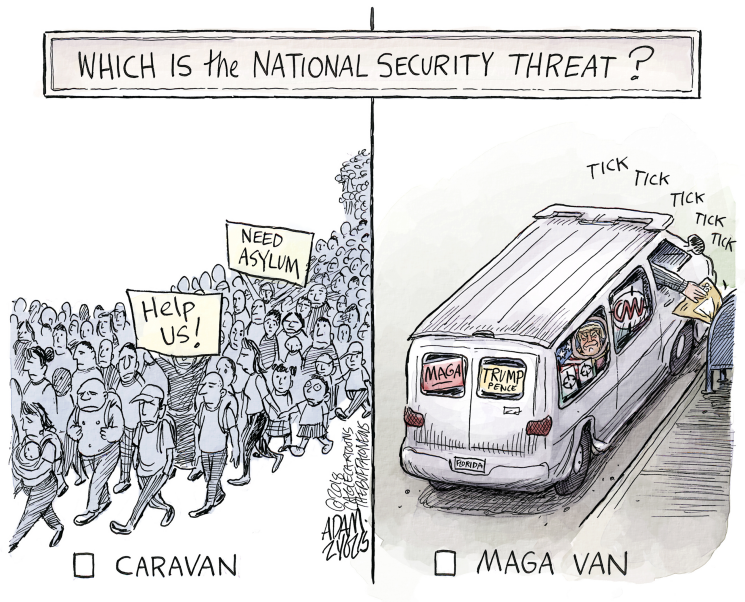
I’m going to say this as calmly as I possibly can: The domestic terrorist’s Trumpist intent was plastered all over his van.

The faces of prominent liberals and Democrats were framed with crosshairs. Trump has repeatedly railed in demagogic language against Obama, the Clintons, John Brennan, Maxine Waters, CNN, and George Soros – and the domestic terrorist, duly inspired, sent bombs to (among others) Obama, the Clintons, John Brennan, Maxine Waters, CNN, and George Soros. To borrow a phrase from the Old Testament, Trump, having sowed the wind, is now reaping the whirlwind.

It was inevitable that a Trump cultist would be sufficiently moved to plot a mass assassination. Words matter. This country is littered with losers who are jonesing to make their mark by translating incendiary words into action. What’s the point of listening to Trump rail against CNN, and displaying a van sticker that rails against CNN, unless you’re gonna do something about it?

Michael Gerson, the ex-Bush senior aide and reality-based conservative commentator, nailed it Thursday (prior to the arrest) when he wrote that Trump’s habit of blaming the media “is like a leper blaming the mirror for his sores.” He wrote that Trump’s rhetorical “poison” invites his partisans “to live in a dream world of ideology and conspiracy… And it is damaging because it provides permission for copycat prejudice … We have a president who summons the darkness. It is sad and sick that so many have responded.”

So when Trump declares that “we must unify as a nation in peace, love, and in harmony” (not to be confused with Elvis Costello’s lyrics calling for “peace, love, and understanding”), we know that it’s pro forma rhetoric with all the value of a wooden nickel. He’s like the brat kid, the budding sociopath, who’s shoved in front of the school principal to mouth a rote apology after trashing the classrooms. Soon enough, he’s back to mischief with a fatal dearth of self-awareness.

What we’re suffering now was glaringly foreseeable three years ago. As I warned back in December 2015, at the dawn of the primary season, “we’re in danger of embracing a very American version of autocracy … What an aspiring autocrat needs most is something visceral to exploit. And what we have today, particularly within a subset of the Republican electorate, is fear and anger and a yearning to lash out … Do we really want to flirt with autocracy? Are we not better than our basest instincts?”

Apparently not. Mailing bombs to Trump’s critics is the inevitable manifestation of those instincts.

But let’s invite Elvis Costello to ask his own questions:

As I walk through

This wicked world

Searchin’ for light in the darkness of insanity

I ask myself

Is all hope lost?

Perhaps we’ll find out a week from Tuesday, when America votes.

Copyright 2018 Dick Polman, distributed exclusively by Cagle Cartoons newspaper syndicate.

Dick Polman is the national political columnist at WHYY in Philadelphia and a “Writer in Residence” at the University of Pennsylvania. Email him at [email protected].

Comments Off on Trump Sows the Wind, Reaps the Whirlwind
There’s One Big Loser in the Kavanaugh Fight

As we sift the mounting wreckage of the Brett Kavanaugh nomination, what happened in 1992 seems quite pertinent.

That year, when the U.S, Supreme Court upheld Roe v. Wade, three of the majority justices were candidly concerned that Americans angered by the ruling might lose faith in the nation’s top judicial institution. They wrote that “the court’s legitimacy depends on making legally principled decisions under circumstances in which their principled character is sufficiently plausible to the nation.”

Ponder those words, then ask yourself whether many Americans will view the high court as legitimate, as having a “principled character” if a credibly accused sexual assailant, a Trumpian partisan who rails about conspiracies plotted by “the Clintons,” is ultimately awarded with a lifetime appointment. And the reverse is true as well. As yourself whether many Americans – on the flip side of the ideological divide – will view the high court as legitimate if (in their view) a stellar conservative candidate is ultimately denied a lifetime appointment thanks to the feminists in cahoots with the Democrats.

It’s obvious by now that Donald Trump has done great damage to a number of institutions, and it’s no surprise that he would wreak havoc on the Supreme Court by nominating a poster child for white male grievance. Still, some nuance is necessary. The electorate has been grievously polarized for more than generation, and the Supreme Court’s perceived legitimacy has suffered as a result. Trump and his Senate enablers are merely making things worse.

The public mood was relatively sedate back in 1992, when the aforementioned trio of justices – Sandra Day O’Connor, David Souter, and Anthony Kennedy – fretted about legitimacy. The public mood was far more tempestuous in December 2000, when five Republican appointees stopped the Florida recount and awarded the presidency to the popular-vote loser, George W. Bush. Much was written that winter about whether the court had dealt a major blow to its legitimacy; indeed, Republican appointee John Paul Stevens warned in his dissenting opinion that the real loser in the ruling was “the nation’s confidence in the (court) as an impartial guardian of the rule of law.” Confidence in the court soared that winter among grassroots Republicans, but plummeted elsewhere in the electorate.

In 2012, Chief Justice John Roberts was reportedly so sensitized about public perception of the court that he switched his thumbs-down vote on Obamacare, believing that a 6-3 majority would convey more legitimacy. Today, in retrospect, given all that has happened since, his gesture on Obamacare looks downright enlightened.

Here’s what has happened since: After Antonin Scalia’s death opened a seat, Senate Republicans refused to even schedule a hearing for Obama nominee Merrick Garland, holding the seat open for nearly all of 2016, claiming that they wanted to let “the people” decide how the seat should be filled. This was naked partisan politics, an unprecedented act of obstruction.

“The people” responded on Election Day by electing a president who won nearly three million fewer votes than his opponent. Then came Neil Gorsuch, who took Garland’s rightful seat. Then came a hue and cry about the tainted image of the court. Russ Feingold, a former Democratic senator and Judiciary Committee member, warned before Gorsuch’s ascent that his confirmation would set “a dangerous precedent from which the legitimacy of our highest court might never recover.”

Then came the unexpected retirement of Anthony Kennedy; his announcement, this past June, conveniently maximized the prospects of a successor being confirmed by a Republican Senate – urgent timing, given the possibility that Democrats could capture the Senate in November.

That brings us to Kavanaugh, who’s now the subject of an eleventh-hour FBI probe that may or may not be sufficiently comprehensive. If a narrow FBI probe provides sufficient cover for the GOP’s fence-sitters to vote Yes, that result could sow more hostility toward the court and its future rulings. Although, of course, the MAGA faction would be delighted.

To quote a fellow political analyst, David Wasserman: “A broken Senate will eventually produce a SCOTUS viewed by many as illegitimate.” The optimists among us would contend that our institutions are strong enough to weather any storm, and that this too shall pass. Maybe. But all we can hear right now is the thunder. As the comic team of Laurel and Hardy would probably say to Trump and his Senate minions, “What a fine mess you’ve gotten us into now.”

Copyright 2018 Dick Polman, distributed exclusively by Cagle Cartoons newspaper syndicate.

Dick Polman is the national political columnist at WHYY in Philadelphia and a “Writer in Residence” at the University of Pennsylvania. Email him at [email protected].

Comments Off on There’s One Big Loser in the Kavanaugh Fight

Republicans Determined to Alienate as Many Women as Possible

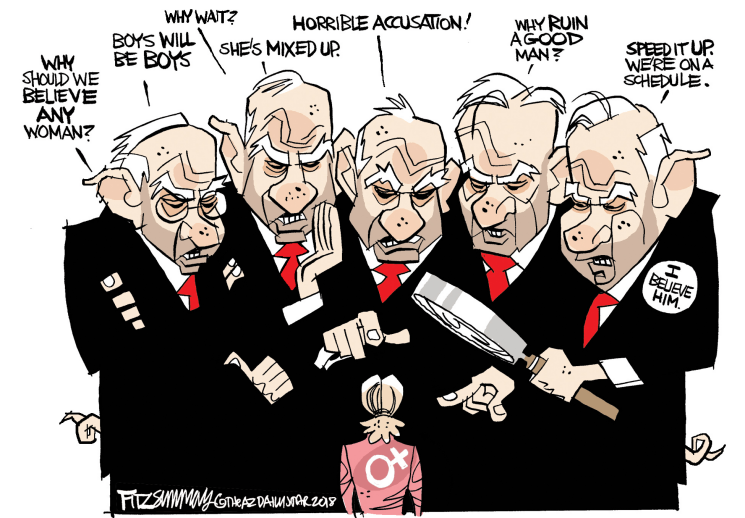
Why are Republicans so determined to stick with Supreme Court nominee Brett Kavanagh, soiling themselves in the process and alienating as many women voters as possible?

I see three reasons: Donald Trump views Kavanaugh as survival insurance (given his past writings), Trump is loathe to admit defeat, and the party’s aggrieved white men apparently believe in all sincerity that the female of the species is bent on destroying them, and thus must be fought at all costs.

Dumping Kavanaugh at this point, now that a credible second woman has come forward, should be a no-brainer. There are plenty of prospective judges in the Federalist Society factory who’d be willing to overturn Roe v. Wade. But that would mean starting from scratch, with new hearings and new social calls on Capitol Hill, and the Republicans don’t want to stretch the timetable past the midterm elections. Especially if Democrats were to recapture the Senate (which is possible, but not probable).

Republicans know they’d look bad if they tried to hustle a new ideologue onto the high court during the post-election lame-duck session. On the other hand, they don’t seem to care much about looking bad. Their current behavior makes that perfectly clear.

What a freak show they’ve been conducting. They’ve been trying to rush the confirmation process – denying Christine Blasey Ford the courtesy of an FBI review (which Anita Hill was accorded), refusing to schedule additional testimony (and considering Brett pal Mark Judge’s misogynist track record, no wonder) – because they wanted to minimize the risk of more horrific revelations. Indeed, according to The New Yorker, some Senate Republican staffers knew last week about Deborah Ramirez, the Yale classmate who now says that Kavanaugh waved his penis in her face. Nevertheless, in the words of Mitch McConnell, Republicans intend to “plow right through.”

And their attitude is best illustrated by the Ed Whelan sideshow, a classic case of right-wing character assassination.

Whelan, a longtime conservative operative and pal of Kavanaugh’s, announced that Ford may have been attacked by someone who merely looked like Kavanaugh – an innocent person with no links to the incident he identified publicly. Meanwhile, a right-wing public relations firm known as CRC hyped Whelan’s fake news.

When the whole farce blew up in Whelan’s face, he abjectly apologized. Then Garrett Ventry, a spokesman for the Senate Judiciary Committee (actually, a CRC employee on loan to the committee) rushed out a statement that the panel “had no knowledge or involvement” in Whelan’s scheme. After that, Ventry resigned from the committee, because he has been accused of… wait for it… sexual harassment.

I’ve written in the past that the GOP’s behavior in the Kavanaugh affair seems almost calculated to widen the gender gap and drive more women voters into the midterm Democratic camp. Now we’re starting to see the evidence. A new USA Today poll says only 31 percent of Americans support Kavanaugh’s confirmation, a new low, and that the hostility is driven by women voters, who now oppose him by a nearly 2-1 margin (23 percent yes, 43 percent no). Other recent polls find a similar pattern.

It’s doubtful that Trump did his nominee much good by tweeting that if Ford’s teenage allegation was real, she would’ve promptly reported it to the police. White House aides had reportedly hoped that Trump would duct-tape his fingers and stay out of the fray, but alas, he could not resist. Surely there are still some women left to alienate. He says now that he’s standing with Kavanaugh “all the way.”

And assuming that he and the misogynistic Republicans hold firm in the days ahead, it’s doubtful that Andrew Puzder’s outburst will help. You may remember Puzder; he was briefly Trump’s Labor secretary nominee. On Saturday, he lamented in a tweet that Ford’s sexual assault allegation was evidence that ” nothing is sacred in the Left’s pursuit of power.” He omitted the fact that his ex-wife accused him of domestic violence – which she described years ago on national TV while wearing a disguise to protect her identity.

How can Kavanaugh possibly lose when he’s defended by the best people?

Copyright 2018 Dick Polman, distributed exclusively by Cagle Cartoons newspaper syndicate.

Dick Polman is the national political columnist at WHYY in Philadelphia and a “Writer in Residence” at the University of Pennsylvania. Email him at [email protected].
Comments Off on Republicans Determined to Alienate as Many Women as Possible

All Talk, No Action: A Republican Metaphor

Congressional Republicans continue to abet and excuse Donald Trump’s relentless assaults on democratic norms and the rule of law. But if we were to focus on one particular guy who best embodies that spinelessness, someone who is a veritable metaphor for a party in moral eclipse, I strongly nominate Ben Sasse.

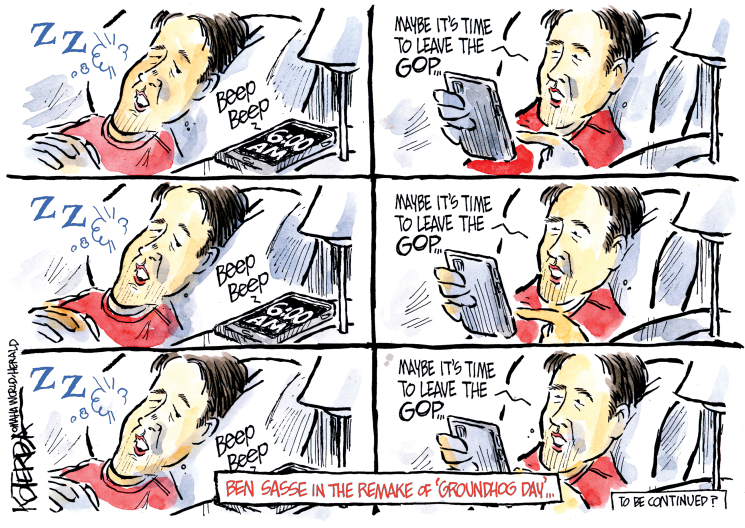
The junior Republican senator from Nebraska has been furrowing his brow about Trump ever since the 2016 campaign, tut-tutting in high-minded language about how the paranoid narcissist is a clear and present danger. But rarely in modern times has such eloquent rhetoric been twinned with such hapless inertia. He talks like a sane person, but whenever the chips are down, he enables Trump’s insanity by doing nothing.

After everything that’s happened over the past week, I can’t listen to Sasse anymore.

When an anonymous senior Trump administration staffer wrote in The New York Times that aides are working overtime to protect America from an amoral loon, Sasse confirmed the substance of the piece. He said it was “similar to what so many of us hear from senior people around the White House, you know, three times a week.” Well, that’s nice to know. The so-called commander-in-chief is mentally unhinged and policy-ignorant, and Sasse and his colleagues learn this anew “three times a week.”

When Sasse surfaced on “Meet the Press,” he continued his lament: “The president was elected in 2016 because he wanted to disrupt everything … The question is, disruption to what end? … It’s pretty clear that this White House is a reality show-soap opera presidency … Right now, it just feels like there’s way too much drama every day.”

But what is he prepared to do about it? Nothing, except to pine for a Trump regime that will never be: “What you’d like is… a policy process where a president can in a dispassionate way deliberate about lots of information and lots of advice and wisdom and counsel and then make a long-term decision.” Trump needs to focus on “long-term vision-casting for America … 10 years in the future, not 10 hours in the future.”

Right. All that will happen on the same day that unicorns cavort on the South Lawn.

And when Brett Kavanaugh was grilled last week by the Senate Judiciary Committee – and it became obvious that he has lied under oath about his past use of hacked Democratic emails, and that he won’t recuse himself from cases involving Trump ,’ did committee member Ben Sasse voice a desire to stop Kavanaugh’s ascent? Nope. He’ll vote yes, along with the rest of the Senate GOP. His big contribution to the hearings was an unprofound assessment on day one about how the confirmation process has become “an election battle for TV.”

Sasse, a Yale history PhD and former small-university president, constantly depicts himself as a free-thinking soul who claims not to care whether he gets re-elected in 2020. And he likes to fret publicly about how Trump has ruined the Republican brand (he said in July, “I think my party is in a bad way”). But if that’s how he feels, and if he’s truly indifferent about re-election in a state that Trump carried by 25 percentage points, why not put his words into action?

The GOP barely holds the Senate, 51-49. The chamber could be tied in knots if only Sasse joined forces with Jeff Flake and Bob Corker. Like Sasse, Flake and Corker talk big about Trump and do nothing. And they have less of an excuse, because they’re 2018 lame ducks who will be gone in January. Three renegade Republican senators, backing their words with action, could arguably hold up Kavanaugh’s nomination – or halt other Trump priorities – unless the Senate leadership first agrees to move the bill, currently in limbo, that protects Robert Mueller from being fired; or move the bill, currently in limbo, that curbs Trump’s ability to unilaterally start a war; or move a bill, currently in limbo, that would better protect our elections from foreign cyberattacks.

But Sasse’s refusal to use senatorial leverage renders his words hollow. History will be harsh on those who saw danger and shrank from confronting it. Trump is counting on all Republicans to remain gutless.

As the philosopher John Stuart Mill warned in an 1867 address, “Bad men need nothing more to compass their ends, than that good men should look on and do nothing.”

Copyright 2018 John L. Micek, distributed by Cagle Cartoons newspaper syndicate.

An award-winning political journalist, Micek is the Opinion Editor and Political Columnist for PennLive/The Patriot-News in Harrisburg, Pa. Readers may follow him on Twitter @ByJohnLMicek and email him at [email protected].

Comments Off on All Talk, No Action: A Republican Metaphor

Democratic Diversity is Making America Great Again

Let’s begin with a biographical sketch, a very 21st-century American dream.

When David Hallquist was a child attending Catholic schools in Syracuse, New York, he always felt female. He knew he was “different,” but he couldn’t find a word for it. He hid his impulses and played men’s sports at school. He pursued a career in energy technology, got married, raised a family, and finally, in 2004, he began the long process of coming out. Six years later, he confided his secret side to his family. And in 2015, his son made a movie, entitled “Denial,” that publicly tracked his transition to who she is today, Christine Hallquist.

Then, at a women’s march in Montpelier, Vt. this past January, Hallquist had an epiphany. She later said, “One of the things the Me Too movement has been pushing is that we need to get involved in politics.” So she did. She filed as a candidate for governor of Vermont, and in the state’s Democratic primary, she became the first transgender woman in America to win a major party nomination.

Christine epitomizes the 2018 Democratic zeitgeist. On the cusp of the autumn general elections, grassroots Democrats have sharpened their message that diversity will make America great again. Despite the Trumpist Republicans’ relentless attempts to turn back the clock, the inexorable future awaits confirmation in November.

With virtually all the primaries completed, Democratic voters have made it abundantly clear that they want more women in elective office. At this point, 200 women ,’ 155 of them Democrats ,’ have won their House primaries in 2018. That’s a record, trumping all previous records. Viewed from another angle, 41 percent of all Democratic nominees ,’ and 48 percent of all non-incumbents -are women. That too is a milestone. (Women are only 13 percent of the GOP’s nominees.)

This surge of women candidates, with heavy support from Democratic women voters, may be historic, but it’s not a huge surprise ,’ given how fervently most women (with the probable exception of blue-collar white women) have come to detest Trump. If his goal this year was to talk and behave in ways designed to guarantee a female backlash against the party he purports to lead, he can probably chalk that up as one of his few tangible achievements.

Let’s scan the updated national map. Connecticut Democrats chose, as one of their House candidates, a black woman ,’ the first to carry the party banner in a Connecticut congressional race. Minnesota Democrats chose, as one of their House candidates, a Somali-American woman ,’ who’s likely to join a Muslim woman from Michigan in the next Congress.

In addition, a lesbian recently won the Democratic gubernatorial nomination in Texas, a bisexual woman – the sitting governor of Oregon – recently won her Democratic primary, and a black woman recently won the Democratic gubernatorial nomination in Georgia.

Gender news aside, Democratic Party leaders are pinning their hopes on one particular midwestern male. In Speaker Paul Ryan’s Wisconsin district, ironworker and union activist Randy “Ironstache” Bryce defeated a female for the right to contest the Ryan-endorsed Republican, businessman Bryan Steil. Bryce has been buoyed by a sizable war chest, an endorsement from Bernie Sanders and a grassroots Democratic hunger to occupy the seat held by one of Trump’s most spineless enablers. It’s not an impossible quest, considering Barack Obama won the district’s presidential balloting by one point in 2008.

If Bryce can pull off a win in November, despite some personal baggage (arrests for driving under the influence, late payments for child support), it would truly signal that a blue wave was cresting.

And a working-stiff white guy nicknamed “Ironstache,” joining the swelling ranks of women, would be another victory for Democratic diversity.

Jennifer Rubin, the center-right columnist, took it even further, declaring that a “demographically diverse repudiation of Trump up and down the ballot will have obvious consequences for the remainder of his term. It may also be the final opportunity for Republicans to get off the sinking ship, push Trump aside and try to regain their sanity.”

I wince at her confident certitude, but those are indeed the stakes in November.

Copyright 2018 Dick Polman, distributed exclusively by Cagle Cartoons newspaper syndicate.

Dick Polman is the national political columnist at WHYY in Philadelphia and a “Writer in Residence” at the University of Pennsylvania. Email him at [email protected].
Comments Off on Democratic Diversity is Making America Great Again

Donald Trump and ‘The Death of Truth’

The lies rain down on us so relentlessly that we’re often benumbed. Shortly after Donald Trump tweeted last week that the Russians would help the Democrats win the midterms, we learned that the Russians have tried to hack the 2018 campaign of Sen. Claire McCaskill – a Democrat. And minutes after Donald Jr. tweeted that President Obama’s economy never posted two percent GDP growth, we learned that Obama had in fact posted two percent GDP growth 15 times.

Michiko Kakutani, the Pulitzer Prize-winning literary critic, has posed the questions that often bedevil us: “How did this happen? What are the roots of falsehood in the Trump era? How did truth and reason become such endangered species, and what does their impending demise portend for our public discourse and the future of our politics and governance?” She supplies the answers in her new book, “The Death of Truth,” a bleak treatise that ends with a dose of hope.

Consider this my summer book recommendation. I wouldn’t necessarily take her slim volume to the beach, lest you be tempted to drown yourself. But it’s a bracing read nonetheless, because she writes so concisely and incisively, and because she draws wisdom from so many disparate influences.

You’ll be hard-pressed to find another social commentator who can critique Trump and our corroded cultural-political climate by quoting both Vladimir Lenin (rhetoric should be “calculated to evoke hatred, aversion and contempt… of such a nature as to evoke the worst thoughts, the worst suspicions about the opponent”), and The Joker from Batman (“Introduce a little anarchy. Upset the established order and everything becomes chaos”).

It’s tempting to read Kakutani only for her withering assessment of Trump, if only because it’s so on the mark: “Long before he entered politics, Trump was using lies as a business tool. He claimed that his flagship building, Trump Tower, is 68 floors high, when, in fact, it’s only 58 floors high. He also pretended to be a PR man named John Barron or John Miller to create a sock puppet who could about his – Trump’s – achievements. He lied to puff himself up, to generate business under false pretenses, and to play to people’s expectations… like most successful advertisers – and propagandists – he understood that the frequent repetition of easy-to-remember and simplistic taglines worked to embed merchandise and his name in potential customers’ minds.”

But Kakutani, the newly retired New York Times book reviewer, seeks to put Trump in context. Her goal is to paint the big picture: “Trump’s unhinged presidency represents some sort of climax in the warping of reality, but the burgeoning disorientation people have been feeling… traces back to the 1960s, when society began fragmenting… The assault on truth and reason that reached fever pitch in America during the first year of the Trump presidency had been incubating for years.”

She got that right. Many factors brought us to where we are today, most of them obvious only in hindsight. We’re living in the perfect storm, and Trump – its mutant byproduct, brilliantly abetted by the Russians’ exploitation of America’s fractures – is reaping the whirlwind.

I’ll leave the historical details to Kakutani. Suffice it to say that the cultural schisms of the 1960s, triggered primarily by the Vietnam war and “permissive” anti-establishment lifestyles, shattered the broad national consensus. Social and political polarization accelerated with each passing decade, and the divide was exacerbated during the 1990s by the rise of conservative media (especially Rush Limbaugh). Scholars on the left and right assaulted objectivity by preaching the gospel of postmodernism.

If you’re wondering what that is, Kakutani defines it as shedding objective reality to enshrine “the principle of subjectivity.” In other words, more and more people define their own factual truth by going with their gut and their biases.

There’s also the internet, which she writes has “led to a cascade of misinformation and relativism, as evidenced by today’s fake news epidemic” – a fertile climate for exported Russian propaganda, what the Rand Corporation, in a report, calls “a fire hose of falsehood.”

Is there any hope that America can reverse the atrophy of truth? Among the cacophony of voices in this eloquent book – everyone from John le Carre to George Washington – we get this, from fired acting attorney general Sally Yates: “Not only is there such a thing as objective truth, failing to tell the truth matters. We can’t control whether our public servants lie to us. But we can control whether we hold them accountable.”

Kakutani concurs: “There are no easy remedies, but it’s essential that citizens defy the cynicism and resignation that autocrats and power-hungry politicians depend upon to subvert resistance.”

Which is why the 2018 midterms are a crossroads for this country. All we have is our will to resist.

Copyright 2018 Dick Polman, distributed exclusively by Cagle Cartoons newspaper syndicate.

Dick Polman is the national political columnist at WHYY in Philadelphia and a “Writer in Residence” at the University of Pennsylvania. Email him at [email protected].

Comments Off on Donald Trump and ‘The Death of Truth’

Lots of Tips on How to Live Sanely in Trumplandia

The pollsters at Pew recently reported that 68 percent of Americans are suffering from news exhaustion, and that jibes with what I witness on an anecdotal basis. I don’t presume to everyone, but many of you probably agree that conversations with friends these days are sometimes strained. The dialogue often goes something like this:

“We’ve gotta talk about Trump and everything that’s going on.”

“I’m so sick of it. Must we?”

“How can we not?”

“Can’t we talk about something else?”

Sure we can. But we’re also well aware (or we certainly should be) that democracy at home and the western peacekeeping alliance abroad are under unprecedented attack by destructive forces in Washington and Moscow. With each passing week, the challenge facing each of us becomes more urgent: What’s the best way to remain vigilant and still lead a sane life? What’s the best way to balance obligations to self, friends, and family with the obligations of citizenship? Is it possible to monitor the avalanche of news without going nuts? How can we best calibrate these factors in year two of Trumplandia?

I brought this up on Facebook recently, and not surprisingly, nearly 100 friends shared their angst and exhaustion.

One popular piece of advice, as articulated by Steve Rosenthal: “No cable news. Repeat, no cable news ever.” Peter Landry seconds that: “I never watch ShoutTV on cable.”Karen Rile says: “Something about large talking heads in the house is particularly stressful.” Glenn Burkins says: “In our house, my wife keeps CNN on constantly, but I have limited my time with (cable) to the time it takes me to walk across our family room.”

Some of my respondents gave shout-outs to Rachel Maddow, Brian Williams, and Nicolle Wallace (I do like Wallace, a career Republican who has great Republican sources), but there seems to be a general belief (which I endorse) that cable commentary is shrill, speculative, repetitive, and therefore easily culled.

Another favorite: Staying off or reducing reliance on Twitter. That’s easier for some than others. I’m pro-Twitter, at least for its usefulness as a breaking news bulletin board. But it’s also a bottomless rabbit hole for ranters, and much time can be wasted crafting pithy ripostes. As Tom Felicetti says, Twitter all too often is a haven for “polarizing emotional non-factual” people. Murray Dubin finds that “closing that Twitter window makes me a little less nuts.”

Matthew Cooper, and others, have zapped the Twitter app off their phones. Some people use their phones more qualitatively; Maria Cardenas says, “I get my news strictly from the BBC app, The Globalist, and NPR podcasts… Sometimes I feel out of the loop but I prefer it to every gory detail.” And some people have found ways to reduce their phone exposure; Bambi L. Feaster says, “I’ve taken to leaving my phone on my desk when I walk the dog… The dog is happier because we play more, walk more, and I’m not impatient.”

Walking the dog is one way to disconnect, but the list of diversions is blessedly lengthy. Baseball appears to be a favorite. Jeff Brown says the Trump news is “relentless and depressing,” so he signed up for the DirecTV ML–package, which is “more soothing,” and I can attest that watching the ML–Network on basic cable is a guaranteed way to dwell for hours in an apolitical bubble.

Exercise is also big. Tom Harkins likes long bike rides. Miriam Hill says, “I am swimming a lot more laps in the pool. My minimum pool workout used to be 1,000 meters. In the last few months, I’ve doubled that on some days just to increase the amount of time my brain gets a break.”

As for me, I’m not the best person to advise anyone on the proper calibration. My latest idea of escapist reading was Daniel Silva’s excellent new spy novel, “The Other Woman” – which turned out to be a parallel-universe tale of Russia’s penetration of America. In the author’s note, he writes: “Russia under Vladimir Putin is both revanchist and paranoid, a dangerous combination… When Putin sows political chaos in Western Europe and seeks to disrupt and discredit an American election, he is reaching deep in the KGB’s playbook.”

I suppose I can escape, albeit temporarily, by hanging with the grandchildren ,’ another popular tip. But my oldest one, who is five, recently informed me with great solemnity: “There are bad guys in the world. You know that, right?” I managed a reassuring smile. But I said to myself: “Yeah. I think I read something about that.”

Perhaps cockeyed optimism is the best escape of all. As Phaedra Trethan says that “while we all know our history is rife with racism, injustice, corruption and genocide, I still believe that arc bends toward justice. Maybe because if I didn’t believe that, I’d have drawn a nice warm bath, gotten in the tub, and opened my wrists by now.”

Copyright 2018 Dick Polman, distributed exclusively by Cagle Cartoons newspaper syndicate.

Dick Polman is the national political columnist at WHYY in Philadelphia and a “Writer in Residence” at the University of Pennsylvania. Email him at [email protected].

Comments Off on Lots of Tips on How to Live Sanely in Trumplandia

Trump Buys Survival Insurance From Brett Kavanaugh

Feel free to tell yourself that Donald Trump chose Brett Kavanaugh for the Supreme Court because the guy went to Yale (Trump reportedly loves Ivy League creds), or because the guy has been thoroughly vetted by the Heritage Foundation and the Federalist Society (the right-wing groups that have long been funneling conservative judges to the bench).

But if you really want to know why Trump chose Kavanaugh, just check out the article he wrote in 2009 for the Minnesota Law Review. He said that serving presidents should be exempt from all criminal and civil investigations – because they’re just too darned busy doing the people’s business. He teed up his argument on page 1,460:

“I believe it is vital that the President be able to focus on his never-ending tasks with as few distractions as possible. The country wants the President to be ‘one of us’ who bears the same responsibilities of citizenship that all share. But I believe that the President should be excused from some of the burdens of ordinary citizenship while serving in office.”

Then came this, on page 1,461:

“Congress might consider a law exempting a President – while in office – from criminal prosecution and investigation, including from questioning by criminal prosecutors or defense counsel… Even the lesser burdens of a criminal investigation – including preparing for questioning by criminal investigators – are time-consuming and distracting. Like civil suits, criminal investigations take the President’s focus away from his or her responsibilities to the people. And a President who is concerned about an ongoing criminal investigation is almost inevitably going to do a worse job as President.”

There you have it, folks. Trump has purchased survival insurance.

Yes, Kavanaugh’s ascent will virtually cement a 5-4 conservative majority for decades, tilting America further rightward on everything from civil rights to corporate power, but Trump would’ve punched that ticket by choosing anyone on the Federalist Society’s wish list. As they say at Wharton, Kavanaugh is “value added.” He has the requisite conservative creds, plus he’s on record saying that presidents should be exempt from investigation. Trump’s knowledge of jurisprudence could probably fit in a thimble, but he has a feral instinct for saving himself. Indeed, it has been confirmed in news reports that Trump’s aides flagged that law review article for his edification.

So if or when Robert Mueller’s investigation lands in the laps of the justices, on some crucial point of law, Trump can probably count on Kavanaugh to serve his interests by arguing that Mueller is burdening a very busy man and that therefore Trump shall not deign to honor a Mueller subpoena. That’s the kind of fealty Trump craves.

Senate Democrats, who are virtually powerless to block Kavanaugh’s ascent (in part because some of the red-state Democrats up for re-election could vote Yes), may well argue during the confirmation process that Kavanaugh should recuse himself if he’s confronted with the Mueller probe, or with the current defamation suit that accuses Trump of sexual harassment – on the grounds that he shouldn’t sit on any case that involves the president who nominated him. Good luck making that stick.

By the way, there’s a very funny moment in the Law Review article when Kavanaugh unveils his exempt-the-president argument and quickly adds: “This is not something I necessarily thought in the 1980s or 1990s.” Yeah, no kidding. Because in the 1990s, as a lawyer with a Republican track record, he served on Kenneth Starr’s team, in criminal pursuit of President Clinton.

At one point Kavanaugh told Starr in a memo, “I am strongly opposed to giving the president any break.” So he had no qualms then about investigating a serving president (of the opposing party, anyway). Suffice it to say that he has since changed his mind.

Can Trump count on Kavanaugh’s loyalty when the chips are down? Perhaps the nominee gave us a hint on Monday night, when he thanked Trump for the honor and immediately went into hyperbolic overdrive: “No president has ever consulted more widely, or talked with more people, from more backgrounds, to seek input about a Supreme Court nomination.”

How could he possibly know that? Why should we believe that? If Brett Kavanaugh wants the American people to believe that he’ll function as an independent member of the supposedly independent judiciary, and that he’ll have an open mind when confronted by a potential constitutional crisis, it would surely behoove him not to sound like the daffy doctor who said that Trump was virtually the healthiest human specimen since the dawn of man.

Copyright 2018 Dick Polman, distributed exclusively by Cagle Cartoons newspaper syndicate.

Dick Polman is the national political columnist at WHYY in Philadelphia and a “Writer in Residence” at the University of Pennsylvania. Email him at [email protected].

Comments Off on Trump Buys Survival Insurance From Brett Kavanaugh

Hey, Democrats: It’s The Supreme Court Stupid

Hey, Democrats: It’s The Supreme Court, Stupid

My advice to Democrats – which I’ve offered for free since the dawn of this century – is that they pound this mantra into their thick skulls: “It’s the Supreme Court, stupid.”

But it’s probably too late for Democrats to acknowledge the obvious. One titanic reason why Trump-allied Republicans are now on the cusp of crafting a right-wing court for the next 40 years is because they always prioritize the court as a campaign issue and rallying cry. Democrats never do. Now they’ll suffer the consequences.

I’m frankly at pains to explain why most blue voters (especially blue-leaning voters who stay home) don’t seem to understand that the person in the White House has the power to shape the bench that has the final say on virtually every hot-button issue in American life. Or maybe most blue voters understand this perfectly well, but prefer to assess their candidates in terms of purity – thereby deciding that flawed Hillary Clinton was really no better than the GOP’s grifter.

My question for them – after last week’s string of pro-gerrymandering, pro-Muslim ban, and anti-labor rulings; and in the wake of Anthony Kennedy’s retirement announcement – is simply this: Happy now?

Trump’s voters were far more ginned up about the future of the court. By contrast, Clinton’s voters (and potential Clinton voters who went AWOL or voted third party) yawned about the court’s tilt, and yawned about Mitch McConnell’s outrageous blockage of Obama nominee Merrick Garland.

The national exit polls tell the tale: 21 percent of all voters cited the Supreme Court as the “most important” factor in their voting decision. Among those folks, Trump swamped Clinton by 15 points (56-41). Among the 14 percent of voters who said the court was “a minor factor,” Clinton won by nine points (49-40). Among the 14 percent of voters who said the court was “not a factor at all,” Clinton stomped Trump by 18 points (55-37). And those stats don’t include the Democratic leaners who skipped the ballot or embraced Jill Stein.

In a nutshell, Democrats want purity; Republicans want power. Social and religious conservatives – who have been fixated on the court for decades – made peace with Trump’s serial lying and abhorrent moral failures because he was their best hope for a post-Scalia conservative bench.

Evangelical Christians, in particular, decided that it didn’t matter in the scheme of things that Trump was a detestable person. Mike Pence, one of their own, persuaded them to look at the big picture. They responded by voting for Trump in a landslide, 81 percent to 16 percent – the widest margin of any 2016 voting constituency.

And that’s how the Republican establishment fell in line. John Boehner, the ex-House speaker,said during the campaign that Trump’s behavior “disgusted” him. Nevertheless, “The only thing that really matters over the next four years or eight years is who is going to appoint the next Supreme Court nominees … The biggest impact any president can have on American society and on the American economy is who’s on that court.”

We also need to remember what happened in the 2014 midterms. Thanks to the usual anemic Democratic turnout – minorities and Millennials typically skip the midterms – Republicans seized control of the U.S. Senate. That’s what empowered McConnell to deny Garland a nomination hearing in 2016, and that’s what will empower him to confirm Kennedy’s right-wing successor this autumn, before voters have a chance to weigh in on the Senate’s 2019 composition. Everything is connected.

I still have the notes from a 1999 conversation with William Kristol, the conservative activist-commentator, who told me: “The biggest impact the next president will have on domestic policy will be in the realm of (high) court appointments. There are so many big things facing the court in the next few years – school choice, affirmative action, church-state issues, abortion.”

And now conservatives – via their legal groups, which have long been nurturing a farm team of court players – are poised to give Trump a reliable nominee who’s likely to become the fifth vote to overturn Roe v. Wade and re-criminalize abortion. This will be Trump’s court now; this is one promise he has kept.

So, for the umpteenth time: It’s the Supreme Court, stupid. And elections have consequences.

One of these decades, the Democratic party and its most apathetic voters might conceivably learn those lessons.

Copyright 2018 Dick Polman, distributed exclusively by Cagle Cartoons newspaper syndicate.

Dick Polman is the national political columnist at WHYY in Philadelphia and a “Writer in Residence” at the University of Pennsylvania. Email him at [email protected].

Comments Off on Hey, Democrats: It’s The Supreme Court Stupid

Will Trump’s Kid Cruelty Sink the GOP in November?

It may seem crass to discuss the potential political impact of Trump’s family separation policy – especially when we can hear the kids wailing for their parents – but we do need to ask:

Is this finally the issue that will shock voters back to sanity? Is this finally the issue that will prompt Democratic-leaning Americans, who usually skip the midterms, to punish the Trump-abetting GOP, turn the House blue, and deal a major blow to Trump’s racist authoritarian dreams?

Maybe there’s reason to hope. Even Anthony “The Mooch” Scaramucci, the short-lived Trump flack, says that the TV “optics” of little kids crying for their moms are bad for a president who understands the power of imagery. He tells CNN, “It’s not good for the Congress if we want to win the midterms.”

Chris Warshaw, a political scientist at George Washington University, having crunched the poll numbers from Quinnipiac and Ipsos, says that public support for Trump’s caging of kids is the lowest for any policy proposal in the last 30 years. And one of the most highly motivated cohorts in the projected midterm electorate – women – are especially contemptuous.

According to Quinnipiac, 66 percent of voters (including 68 percent of independents) gave a thumbs down to Trump administration’s no-tolerance policy. Women in particular were more fervent about it. A whopping 70 percent said they were opposed; only 22 percent supported. Those were the stats for all women, including minorities. But the numbers were virtually the same for white women (65 percent opposed, 25 percent support) -and that’s significant, because a majority of white women voted for Trump in 2016.

The obvious risk for Trump and the GOP (even as Trump continued to fake-blame “Democrats” for the policy he owns) is that women in particular won’t vote for a heartless party that treats children like animals. As one Republican strategist told NBC News, “The media will broadcast these images of brutality and chaos, and the public will associate them with the Republicans that run the House and Senate.” A second GOP strategist said, “The images are devastating.”

The pollsters at Ipsos basically asked people whether they agreed with Jeff Sessions’ argument that the separation policy is designed to be a deterrent. But again, the public signaled strong opposition; 56 percent said the policy is inappropriate, only 27 percent signaled support. And that sentiment was stronger among women; 59 percent oppose it, only 23 percent support it.

Granted, it’s only June. One dares not even imagine what else Trump will do between now and November, with only a smattering of Republicans bleating empty words. But Trump being Trump, he shows no signs of backing away from his border brutality. According to projections by the Department of Health and Human Services, the number of undocumented immigrant kids in federal custody could top 20,000 by August.

That should keep the issue alive for the electorate. Stephen Miller, the white nationalist adviser who pushed for Trump’s policy, apparently thinks it’s a boffo way to gin up white-grievance midterm turnout, but his strategy may well backfire. The Ipsos poll reports that only 46 percent of self-identified Republicans support family separation, and that’s a very low figure for a party that typically marches in lockstep. Meanwhile, the slice of the electorate that rightly detests Trump – the same slice that has triggered Democratic wins in scores of state and federal special elections – now has another issue to stoke its ire. And because it’s about children, it’s arguably the most visceral issue of all.

Trump, of course, has the power to pull the plug and prevent his opponents from using it against him. As he said at the 2016 Republican convention, referring to America’s ills, “I alone can fix it.”

So fix it already. Do it for the kids.

Copyright 2018 Dick Polman, distributed exclusively by Cagle Cartoons newspaper syndicate.

Dick Polman is the national political columnist at WHYY in Philadelphia and a “Writer in Residence” at the University of Pennsylvania. Email him at [email protected].

Comments Off on Will Trump’s Kid Cruelty Sink the GOP in November?