Do you trust your significant other?

Tyrades! by Danny Tyree

Cheaters never prosper.

But people who expose cheaters make out like bandits.

According to USA Today, “loyalty tests” are blowing up online.

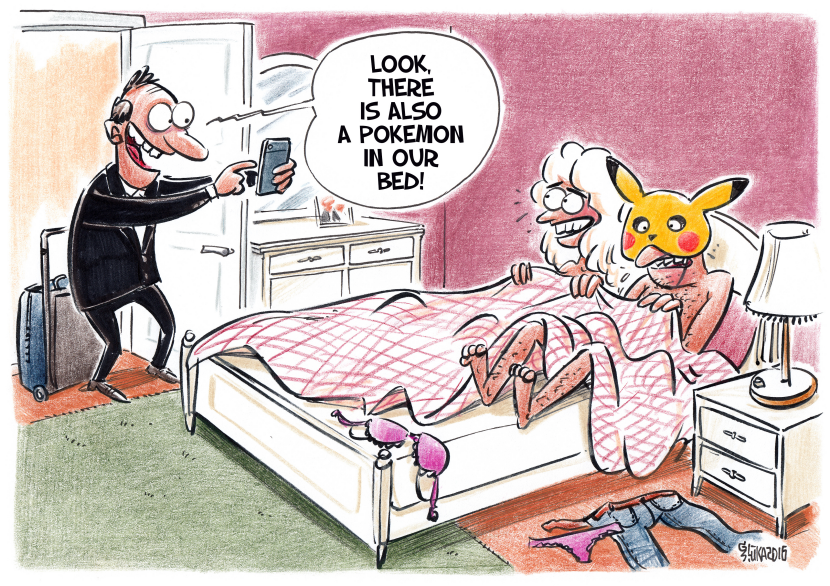
That’s because an alarming number of Americans suffer anxiety over the possible unfaithfulness of their boyfriend, girlfriend, fiance, spouse, inflatable partner (“That doesn’t smell like the air from MY pump!”)…

Civic-minded TikTok users are coming to the rescue. (I say “civic-minded” because they are laser-focused on earning enough to ditch their Honda for a Porsche.)

For a fee, they offer to test/entrap the suspected cheater by flirting with them either online or in person. The temptation may involve salacious comments, skimpy clothing or hints of having a dozen eggs stashed away.

There are even thriving businesses such as Loyalty-Test that act as hubs for testers. I love free enterprise, but I despair that we live in such cynical times. Back in the old days, you could have a romantic partner who phoned in “sick” to skip work for a rendezvous, climbed down from their second-floor bedroom and brandished multiple fake IDs – and rest assured they were paragons of honesty with whom you could grow old together.

The base fee for these interventions can be reasonable, but some testers feel compelled to request hazardous duty pay if your partner is both fickle and needy. (“For our second clandestine meeting, can we go to my grandma’s house for Thanksgiving? You’ll have to take a crash course on speaking Klingon to talk to my family. Speaking of ‘crash,’ can you maybe pay my bill down at the garage?”)

I feel for the people who think a loyalty test is necessary, but I’ve never known such insecurities myself. My wife and I have been each other’s rock for nearly 34 years. Even before we met, if a girl dumped me, it was never a case of competition from another guy, just a mismatched set of life goals. (“You want us to gaze into each other’s eyes, but I’d just as soon watch paint dry.”)

You have to respect the partners who justify the tests with a philosophy of “Better safe than sorry. Look before you leap. You can never be too sure. Trust but verify.” Although, maybe if they didn’t live in Cliche Land their lover wouldn’t be looking for greener pastures!! (“And, oh yeah, you can lead a horse to water but…keep your eyes peeled in case your partner is playing tonsil hockey with that skank back at the stable.”)

Ultimately, neither suspicion-generated manipulations nor rose-colored glasses serve couples well. Take chances on getting to know each other over time.

Besides, life really isn’t life without an occasional heartbreak. As Sir Isaac Newton observed in one of his laws, “Everybody plays the fool sometime. There’s no exception to the rule. Listen, baby.” (Or maybe that was the R&B group The Main Ingredient. You can tell I’ve had a few too many apples fall on my noggin.)

Loyalty-Test told USA Today that 20 percent of the attempted seductions end with the target failing outright. Even allowing for some indecisive reactions, it sounds like a majority of the subjects loyally return to their Significant Other. With the added bonus of an artificially inflated ego!

(“Listen, woman…some foxes would love for me to leave the toilet seat up. And so would their 10 million followers on…oh, crud! *Sigh* Have you seen my air pump? ”)

Copyright 2025 Danny Tyree, distributed by Cagle Cartoons newspaper syndicate.

Danny Tyree welcomes email responses at [email protected] and visits to his Facebook fan page “Tyree’s Tyrades.”

Comments Off on Do you trust your significant other?
You’re not one of those Easter experts, are you?

Tyrades! by Danny Tyree

I suspect a lot of people are now smacking their foreheads and sputtering, “That’s what I should have given up for Lent – listening to experts!”

Yes, regardless of what CNN or the New York Times thinks, we all deserve a break from the roving packs of self-proclaimed, self-aggrandizing, utterly indispensable “authorities” on topics such as economics, health, environment, law, Bigfoot’s assessment of Kierkegaard, etc.

But the Easter season inevitably finds a whole different basket of experts hopping down the trail.

Some are skeptics. Some are backsliders. Some are sanctimonious busybodies. But the overarching reality is that it’s difficult to concentrate on Jesus Christ coming out of the tomb when the experts are coming out of the woodwork.

Jesus was given to announcing, “Verily, verily, I say unto you”; but “surely” is more the speed of these pontificators.

“Surely it was only a nefarious conspiracy that kept the perfectly legitimate Gospel of My Cousin Who Couldn’t Find the Middle East Even If You Pinned It To His Shirt out of the official Bible canon.”

“Surely the God who invented La-Z-Boys and online sports betting wouldn’t mind if I waited until Christmas to mingle with the rest of the faithful.”

“Surely if Jesus was really coming back, he would have returned before that arbitrary date I circled on the refrigerator calendar.”

“Surely the savior who was nailed to the cross could understand the absolute torture I would feel sitting eight rows back from where those hypocrites will be sitting (during the second service).”

“Surely if God wanted us to think of ourselves as something more than the byproducts of a primordial soup, He would have provided each newborn with a laminated, signed, numbered manual hand-written by Jesus.”

“Surely that half-hearted prayer I tossed off for what’s-his-name with the vaguely remembered ailment will go down in history with Jesus’s prayer in the Garden of Gethsemane.”

“Surely I can go through the ‘10 spiritualities or less’ lane, even though I’m sincerely juggling 11 – no, make that 12 – spiritualities at the moment.”

“Surely there’s a special corner of hell reserved for any heretic who has a different estimate for the gross domestic product of first-century Capernaum than I do.”

Yes, people with finite human brains and narrow frames of reference definitely love to throw around the word “surely.”

They might think ventriloquists are corny, but they have no problem trying to put words in God’s mouth.

They might demand, “No excuses!” from those around them; but they have honed their own rationalizing to an art form.

They may not see the incongruity of pairing “in my humble opinion” with the wildest, most self-serving of conjectures; but they demand to be taken seriously!

They may casually dismiss the hope of an afterlife as a “wishful thinking” delusion, but they are oblivious to the flip side that “not being responsible to a Higher Power” could also be wishful thinking.

This should be a season for reverence, renewal and rededication, but too often it is an occasion for academic smugness, frantic loophole-seeking, deep-seated prejudices, “gotcha!” documentaries and self-righteous scolding.

“Be not wise in your own conceits,” Saint Paul wrote nearly two milllenia ago.

Humility does not require high-powered experts. Little children can be humble.

Be like a little child, and surely (!) goodness and mercy will follow you all the days of your life.

Copyright 2025 Danny Tyree, distributed by Cagle Cartoons newspaper syndicate.

Danny Tyree welcomes email responses at [email protected] and visits to his Facebook fan page “Tyree’s Tyrades.”

Comments Off on You’re not one of those Easter experts, are you?

Do you spend 138 minutes a day worrying?

Tyrades! by Danny Tyree

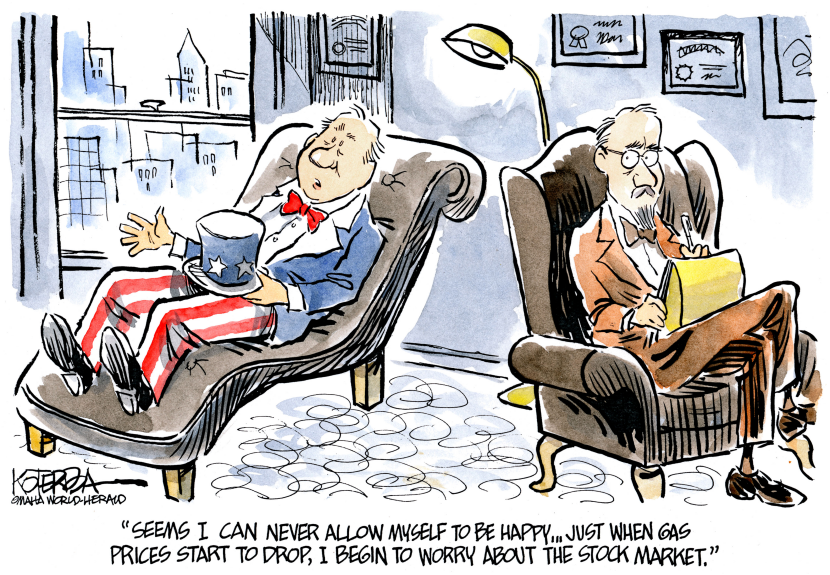
Surely I’m not alone in the phenomenon of dutifully paying my credit card bill by the deadline and then, two weeks into the next billing period, abruptly freaking out with self-doubt. Did I pay it or not?

According to a Talker Research survey of 2,000 Americans across all generations, people on average spend two hours and 18 minutes each day wrestling with worrisome thoughts.

Undoubtedly, these thoughts include concerns such as “Will I be able to pay the rent?,” “Can I convince my ex to agree to joint custody?,” “Can I ever finish my ‘to-do’ list?” and “Should I have the doctor look at this irregularly shaped mole — or go with my original plan and have the exterminator get it out of the yard instead?”

These nagging doubts can impair sleep, hamper productivity and make you as jittery as a long-tailed cat in a room full of rocking chairs. (*Whew* I was worried that I would miss out on that Cracker Barrel product placement opportunity.)

Let’s face it: responding positively to platitudes is not as easy as it used to be. (According to the United States Code Annotated, “Ah, I wouldn’t lose any sleep over it” has now surpassed 99 percent of the permutations of “Yo’ momma…” in the “fighting words” category.)

For example, Louis Armstrong took some of the edge off of the Great Depression when he sang “On the Sunny Side of the Street.” But nowadays when you “grab your coat, grab your hat, leave your worries on the doorstep,” you have to agonize over whether a porch pirate will swipe your worries, bring them back and sue for damages.

And it used to be that children eventually listened to their parents’ reassurances and outgrew anxieties about monsters under the bed. Now we have twentysomethings with lingering fears that maybe they didn’t use the right pronouns for those monsters.

The Serenity Prayer used to bring solace to troubled individuals in AA and beyond. But I understand that it’s being updated to “God, grant me the serenity to accept the things I cannot change; courage to change the things I can; and wisdom to…ah, it’s only Greenland! If we get buyer’s remorse, we can always put it in a national garage sale!”

Baby Boomers and Generation X survived uncertainties such as the military draft and the AIDS epidemic, but now they have profound doubts about the world their children and grandchildren will inherit, and whether those heirs will enjoy the same opportunities as in halcyon days of yore. I understand that an anonymous benefactor has sprung for every town to have (a) a ginormous garden hose for drinking and (b) enough unfiltered Marlboros for “smokin’ in the unisex bathroom.”

On a more positive note, the survey indicates one in 10 young Americans have taken a proactive approach to mental health by cramming all their worry into one dedicated time slot per day. I say that it’s a positive development, but I’m not sure I want to encounter any of these individuals during their hyper-carefree periods. (“I’m having to use the sun roof because I am 10 feet tall and bullet-proof! Yee-haa! Ramming speed!”)

*Ahh* Another column finished and another check dutifully mailed to Visa. Hold on! The check is still here, so what did I put in the envelope? The clothes iron? I hope I turned it off!

Copyright 2025 Danny Tyree, distributed by Cagle Cartoons newspaper syndicate.

Danny Tyree welcomes email responses at [email protected] and visits to his Facebook fan page “Tyree’s Tyrades.”
Comments Off on Do you spend 138 minutes a day worrying?

Can Microsoft really be turning 50?

Tyrades! by Danny Tyree

The world was changed forever on April 4, 1975.

(Don’t get a swelled head if that happens to be your date of birth. I’m writing about a business/cultural milestone, not providing PR for any individual’s decades of leaving a carbon footprint. On the other hand, you really are rockin’ it for near-50. Send me the name of your gym.)

*Ahem* Where was I? Oh, yes, April 4 marks the 50th anniversary of when childhood friends Bill Gates and Paul Allen launched Microsoft, a fledgling company that would grow into a multinational technology conglomerate boasting (as of 2024) 228,000 employees.

(Admittedly, that statistic does not impress long-serving Congressman Cookthebooks, who sputters, “Big deal. I’ll bet not all 228,000 employees are related to the boss! Amateurs!”)

Some of us wonder how we ever got along before Microsoft introduced its productivity applications, goosed the sale of home computers and helped the dot-com boom of the 90s. (I think it had something to do with dipping a quill pen in ink to put dinosaur eggs on the grocery list, but don’t quote me on that.)

But a sizable minority still takes a perverse pride in staying low-tech. (“You won’t catch me using any of that newfangled computer stuff. New evidence is coming out that Microsoft Edge is the Mark of the Beast. I’ll provide you with cutting-edge research about that topic just as soon as the new set of encyclopedias arrives.”)

Beginning with Windows 95 (which I ran on my Dell tower computer back in the day), I have benefited from quite a few Microsoft products. But I must admit that the high subscription costs for certain Microsoft software sometimes drive me to avail myself of the knockoffs that have jumped into the market. Who needs Word software when you can get Inarticulate Grunt for free? Why pay for Excel when you can install Blend In and Ride The Clock Until Quitting Time at no cost?

I have downloaded several useful applications from the Microsoft Store, but I feel bullied when I try to install neat software from another source. It’s almost a HAL “I’m sorry, Dave. I’m afraid I can’t do that” moment. Or more like, “Wellll, you can try installing that unknown software but it might make your laptop explode. And it would probably mess up your computer, too.”

The impact of Microsoft goes beyond mere technological innovation like the Xbox gaming console or cloud computing. Its financial success has enabled the philanthropic endeavors of Bill Gates. Love him or hate him, that globetrotting scamp is always dabbling in something. (“If we can’t find a way to make the world better, we’ll just buy out the competing planets! Easy-peasy. They probably have some really humongous bugs to eat.”)

Some folks — disenchanted with America’s two-party system, the European Union and the United Nations — think Microsoft really should be in charge of the whole world. I can just imagine some of the outbursts we would overhear.

“Hold on! You can’t use your toilet until we’ve completed a forced upgrade at this most inopportune time.”

“Too bad about the much-needed rain stopping in mid-air; maybe you should try a couple dozen reboots.”

“Sorry about all your hair falling out. Sure hope you established a system restore point!”

Here’s to the next 50 years of innovation.

Maybe your gym will even suction fat into the cloud!

Copyright 2025 Danny Tyree, distributed by Cagle Cartoons newspaper syndicate.

Danny Tyree welcomes email responses at [email protected] and visits to his Facebook fan page “Tyree’s Tyrades.”
Comments Off on Can Microsoft really be turning 50?

Will there be horses in heaven?

Tyrades! by Danny Tyree

“When you are on a great horse, you have the best seat you will ever have.” – Winston Churchill

As a lifelong resident of the geographic region that is the epicenter of the storied Tennessee Walking Horse industry (yes, it’s possible to be from a small town without being from the proverbial “one-horse town”), I was intrigued to learn that country music legend Randy Travis recently released a song called “Horses in Heaven.”

Extrapolating from Bible references to the Four Horsemen of the Apocalypse as well as the fiery chariot that carried the prophet Elijah away from this vale of tears, Travis waxes poetic about… God as a cowboy wearing a Stetson hat.

(Guess I missed the Bible verse about “God loves a cheerful product placement.” Mercifully, the song contains no mention of bladder issues and the ensuing “gotta talk to the Man Upstairs about a horse” maneuver.)

The ballad’s lyrics also speculate about thunder being caused by angels riding in a posse. Coincidentally, 37 percent of DEI hires at the National Weather Service demonstrated a remarkably similar understanding of atmospheric phenomena.

The song is (intentionally?) ambiguous about whether the heavenly horses are supernatural creatures or beloved pets who have entered their eternal rest. If the latter, the question remains whether horses get an “all dogs go to heaven” sort of automatic pass, or instead the Almighty demands more of them.

If horses really do need inspiration to straighten up and trot right, “horse whisperers” may someday be replaced with “prosperity gospel shouters.” (“If you don’t have a sugar cube the size of an SUV, you must be doing something wrong!”)

The ideas pictured in the song elicit a wide spectrum of reactions. The populist view is that it would just make good horse sense for those magnificent creatures to be rewarded with a pasture in heaven. (“The book of Revelation says there will be no more death, sorrow or crying. It doesn’t say, ‘no more stalls to muck.’ Onward, Christian soldiers, marching as to dressage!”)

Other animal lovers get misty-eyed about the concept of adventuring forever with a trusted steed, but acknowledge that it’s probably just wishful thinking. (“You can lead a horse to holy water, but you can’t make it fly.”)

And of course, traditionalists think that giving free rein to the idea of animals having souls is downright sacrilegious. (“Forget about rolling boulders. Repent of your heresy or you’ll be putting the cart before the horse for the rest of eternity!”)

Perhaps we could settle the matter once and for all if a horse had a near-death experience and dictated a book about it, sort of “straight from the horse’s stenographer’s mouth.” (“Tell my agent ‘ebook only!’ If there was a hardcover, I would always worry about Uncle Spirit being the glue that holds it together!”)

Wild horses couldn’t drag me away from writing more about this fascinating subject; but a space-conscious editor might. *Sigh*

I feel spurred to search for a different topic. Maybe I’ll do some meteorological research before saddling up for next week’s column.

Hold your horses! You don’t have to warn me about getting a frosty reception from those 37 percent of DEI hires at the National Weather Service.

They’re probably too busy trying to calculate how many fairies have to dance on the lawn to generate a good frost, anyway.
Happy trails to you.

Copyright 2025 Danny Tyree, distributed by Cagle Cartoons newspaper syndicate.

Danny Tyree welcomes email responses at [email protected] and visits to his Facebook fan page “Tyree’s Tyrades.”

Comments Off on Will there be horses in heaven?

Are you a fanatic or what?

Tyrades! by Danny Tyree

I recently attended a memorial service for a longtime acquaintance who was renowned as one of those “if you cut him, he’d bleed University of Tennessee orange” enthusiasts.

I came away self-conscious, because – while I like countless things in this big, beautiful world – I was “curbing my enthusiasm” even before Larry David launched his HBO series.

Sure, my school-age self was more demonstrative. I remember eating with my father at his Kiwanis Club luncheon (at the Southland Cafe in Lewisburg, Tennessee). I made noises like a purring engine while gobbling down the grub. (“Elbows off the table? What about mud flaps?”)

But life’s slings and arrows – and encountering the “in all things, moderation” philosophy – made me keep my emotions buttoned up.

Perhaps my self-doubt since the memorial service is payback for years ago when I mocked a Subway commercial actor who ogled the ingredients in a downright lewd and lascivious manner. (“Go ahead, dude. Get the drink and the chips – and, oh yeah, a room.”)

But Subway guy was just the beginning. I’ve encountered tons of hobbyists, fashion plates and status seekers whose unbridled enthusiasm reminded me of the “irrational exuberance” description that Alan Greenspan attached to the Nineties “dot-com” stock market bubble.

They also remind me of the characters in Al Capp’s “Li’l Abner” comic strip. There was always a senator, industrialist or Dogpatch denizen emitting an audible “*Smack! Drool!*” over a kickback scheme, sexy secretary or prize-winning ham.

(Speaking of ham, I’ve trained myself to exhibit less “hog wild and pig crazy” glee and more “That’ll do, pig – that’ll do” stoicism.)

Seriously, I enjoy food as much as the next fellow (well, more than the next fellow if it’s that fellow who forgets to eat because he’s endlessly writing “fan fiction” within the “See Spot run” universe); but I’m leery of veggie idolaters who stake out the farmers market until they can throw on their poncho and devour their first bushel of tomatoes of the season.

And I appreciate movies and music, but some fanatics are neck-deep in celebrity worship. (“Man, I just discovered this up-and-coming band. I’m going to camp out so I can purchase tickets for their eventual farewell tour.”)

I admire athletes and don’t begrudge them their adulation, but I don’t kid myself about reciprocity. There’s not a Mutual Admiration Society in the locker room chanting, “Slam dunk that lower mortgage rate, Hiram Horsecollar of East Bug Tussle!”

“Different strokes for different folks.” I try keeping that adage in mind; but sometimes it’s hard to live harmoniously with people who rationalize, “I’m agnostic, so I can’t be holier than thou. I have to settle for more obsessive-compulsive than thou.”

Believe me, I try to think good thoughts about all the people who shop ‘til they drop (“Shoe shopping – that would have solved Pompeii’s little dilemma”), treat their lawn to a manicure/pedicure/Brazilian wax or go gallivanting on frivolous quests for world records. (“Just one more country and I’ll have watched paint dry while hopping on one foot in every former Soviet republic. And it took only 15 ‘dead aunts’ to convince my boss I needed the time off.”)

I’ll try loosening up. If I cut myself, I may not bleed orange, but at least I can announce, “Yay! I’m attracting sharks! Love me some sharks! Hey, stop with the purring engine sound…”

Copyright 2025 Danny Tyree, distributed by Cagle Cartoons newspaper syndicate.

Danny Tyree welcomes email responses at [email protected] and visits to his Facebook fan page “Tyree’s Tyrades.”
Comments Off on Are you a fanatic or what?

Are psychic abilities in your future?

Tyrades! by Danny Tyree

“If you could read my mind, love/What a tale my thoughts could tell.” – Gordon Lightfoot

Apparently, my late father was ahead of his time.

Dad once confided in me that he believed in the concept of “universal knowledge” – that God gave humans a finite physical brain to keep them from knowing EVERYTHING.

Now a story from Great Britain’s “Daily Mail” reveals that researchers in Canada have discovered a part of the brain that acts as a “psi inhibitor.”

This region supposedly suppresses the natural psychic, telepathic and clairvoyant abilities the scientists say are trapped in the brains of every human (except for that creep in the next cubicle who, if you read his mind, would give a perfect impression of a “white noise” machine).

Using repetitive transcranial magnetic stimulation (rTMS), the researchers claim they can create “reversible lesions” in the brain and unleash amazing abilities.

“Reversible lesions” is a marketing buzzword right up there with “easy payments” and “some assembly required.” But if it does catch on, look for hucksters to jump on the bandwagon and promise attributes other than mental powers.

“The proportionate strength of a spider? An atomic wedgie can give you that in a jiffy!”

All of us have experienced hunches, gut feelings, weird “coincidences” and flashes of intuition, but science is chomping at the bit to take things to the next level.

(The podcast “The Telepathy Tapes” goes even further, asserting that some autistic individuals display profound abilities such as accessing infinite knowledge and even visiting heaven! Seriously, who wants to be a guest in a place where there’s not even a medicine cabinet to snoop through? But I digress.)

If the research accelerates, anxiety levels will soar for horoscope writers, “gender reveal” party planners, poker players and executives who pride themselves on sizing you up by the strength of your handshake. (“Please, can’t you leave a barrier so I can still judge people by the cut of their jib?”)

Still, it’s not a given that further experimentation with rTMS would be a game-changer for every single human. There will always be “haves” and “have nots.” Activists will have to fight for their fair share of reversible lesions. (“Dude, in Europe they even get socialized concussions as a bonus!”)

True, not everyone will be so passionate about brain modifications. Laid-back skeptics will be unimpressed by the high-tech shenanigans. (“I don’t need to tinker with my brain. My trusty left big toe tells me all I need to know about weather patterns and suchlike. Yep, ol’ Toe-stradamus assures me my cousin should be visiting any day now…”)

Kinkier people will accept enhanced abilities, but with stipulations. (“I’m not so keen about becoming One with the universe. But if you could arrange a throuple with the universe and and an alternate dimension…”)

Don’t be surprised if astounding powers of telepathy, precognition or psychokinesis (“mind over matter”) leave you with the same old struggles. (“I changed my mind about moving that mountain, dear. It clashes with the brook. Could you please just move it back where it started?”)

*Sigh* Dad said there would be days like this. But did he speak from accumulated wisdom or from something jarred loose when toddler me whacked him on the head with an iron pipe?

I guess that’s for me to know and for you to…

Hey! Leave me a FEW secrets!

Copyright 2025 Danny Tyree, distributed by Cagle Cartoons newspaper syndicate.

Danny Tyree welcomes email responses at [email protected] and visits to his Facebook fan page “Tyree’s Tyrades.”

Comments Off on Are psychic abilities in your future?

Would it kill you to buy some antiques?

Tyrades! by Danny Tyree

Besides the omnipresence of cellphones (“those little machines”), my mother’s greatest frustration in her final years was the sluggishness of the antiques market.

Yes, back in my mother’s heyday as a flea marketeer, “the sky is the limit” was the motto for prices on vintage furniture, quilts, butter churns, Gramophone cylinder-record players, hand-cranked wall telephones, Buck Rogers ray guns and other treasures with a Cracker Barrel Old Country Store vibe.

Today’s motto? “Look — up in the sky! It’s a bird, it’s a plane – no, it’s just once-valuable dishes being used for skeet-shooting practice.”

Granted, there are still nods to the glory days (reproduction tin advertising signs at Hobby Lobby, newspaper headlines trumpeting a record-breaking Sotheby’s bid on some high-end objet d’art); but, in general, I understand my mother’s consternation.

The situation may be less dire in your particular geographic location, but many once-bustling antique shops have become like museums. Shoppers have devolved into mere browsers murmuring observations like, “You know who that classic quill pen would be perfect for? That cousin who is no longer on our gift-giving list. Oh, well…”

Why don’t antiques hold as much appeal for Millennials or Gen Z as they did for the Greatest Generation (who lived through the Great Depression) and their Boomer offspring who heard their stories? I mean, besides the fact that 27 percent of younger consumers associate the “Great Depression” with that time Ticketmaster had a 15-second delay in offering Taylor Swift tickets?

Well, for starters, disposable income is certainly an issue. Inflation, high interest rates and student loan debt don’t leave much cash for mule collars and laundry scrub boards. Although, creativity can justify an exception. (“I just had to buy that blacksmith bellows. Talk about vaping in style!”)

Tiny homes do not mesh with some of the heftier antiques. (“I know family lore says this kitchen cabinet came over on the Mayflower, but *grunt* I think it really WAS the Mayflower.”)

The affluence and collector mentality of their elders has probably soured a lot of youngsters on artifacts of yore. Patriarchs and matriarchs used to bequeath the bare essentials of useful-and-or-sentimental keepsakes. Now kids are told, “I know you want to go out with your friends, but you need to dust the 5,000 ‘Joanie Loves Chachi’ Bobbleheads I’m leaving you when I’m dead.”

Slasher movies have made antiques seem quaint and irrelevant. Why decorate your hallway with framed portraits of long-dead strangers when you can revel in images of freshly killed strangers on your 98-inch flat screen TV?

I suspect that some young people would feel shame if surrounded by antiques. Who wants to be reminded of an era when everything was proudly crafted to last? (Only a trademark dispute kept cast-iron long johns off the market.) It’s much more comforting to live in a time of cheap, disposable thingamajigs imported from China. (“Well, if my $1.99 life jacket dissolves in frigid waters, I’ll just order a replacement.”)

Whatever is causing the lack of motivation, I implore youngsters to devote a little time, money and space to the good things of the past.

Drop in on a flea market or estate auction soon.

At least call an antique mall.

But not on one of those little machines!

If God had meant for man to have little machines, He wouldn’t have invented rotary phones!

Or something like that.

Copyright 2025 Danny Tyree, distributed by Cagle Cartoons newspaper syndicate.

Danny Tyree welcomes email responses at [email protected] and visits to his Facebook fan page “Tyree’s Tyrades.”

Comments Off on Would it kill you to buy some antiques?

Shall we salute night-shift workers?

Tyrades! by Danny Tyree

My wife’s sister and her husband have for years both worked third shift (a.k.a. “the graveyard shift”), and they seem to be in good company.

About 20 percent of the full-time workforce in the United States participates in some form of shift work (second shift, third shift, rotating shifts, shifting the blame, shifting to share their flatulence, whatever).

Unfortunately, as many as 40 percent of those workers suffer from Shift Work Sleep Disorder, which can manifest itself as insomnia, uneven sleep, drowsiness at inappropriate times, hypertension and severe irritability. (“I don’t care if they’re dead! Exhume Fred Rogers and Mother Teresa so I can share a few choice words with them!”)

As you’ve probably surmised, sleep disorders come about because nontraditional work hours wreak havoc on humans’ circadian rhythm. Yes, our “internal clock” and hormones expect us to be active during daylight hours and zonked out at night. If nature abhors a vacuum, it downright goes to town with a Louisville Slugger on poor jokers who just want to earn a living after midnight.

It’s not just biology. Needing to sleep in the daytime is like blood in the water attracting sharks. Neighbor Jones decides to crank up a diesel lawnmower for his AstroTurf lawn. Door-to-door salesmen come by hawking solar-powered anvils. Faulty GPS leads homecoming parades down cul-de-sacs. And so forth.

Fires, crime, medical emergencies and production quotas refuse to be boxed in by a “9 to 5” mindset, so we’ll always need late-shift workers; but I’ve endured more than my share of the schedule.

I spent the last 8 years of bachelorhood and the first six years of married life working third shift. It was fun for a year or two, but the lifestyle began to take its toll. (I would’ve dodged the toll booth, but I locked my keys in the car a heck of a lot back then.)

Sure, I would’ve coped better if I had maintained the same sleep schedule seven days a week; but I tried to live like “normal” people on the weekend, for the sake of visiting in-laws, helping with family projects and attending church. (I hope that someday I will hear, “Well done, thou good and faithful servant — for resisting the strong temptation to replace communion grape juice with an energy drink.”)

Why do people work odd shifts? Some do it because of the shift differential in pay or the flexibility of running errands. Some do it because some codger of a co-worker is hanging onto their coveted first-shift job for dear life. (“I won’t abandon my post again. The last time I did, poor Custer…I don’t want to talk about it…”)

Sometimes it’s inertia. You start out on nights “temporarily” and the years fly by without your breaking free of the habit. (“I had a string tied around my finger to remind me to apply for a day job, but that’s the finger I lost to the *yawn* skill saw, darn it.”)

And, of course, the more casual pace is a big selling point. Not so many supervisors, bean-counters and visitors underfoot. The “suits” are in their jammies. The “undercover boss” is literally wrapped snugly in his security blanket.

Whatever their motivation, say “thank you” to those dedicated night-shift workers.

“Thank you” and not “Oh, I’m glad you’re up…sort of. I wanted to ask where you buy your ‘Do Not Disturb’ signs…”

Copyright 2025 Danny Tyree, distributed by Cagle Cartoons newspaper syndicate.

Danny Tyree welcomes email responses at [email protected] and visits to his Facebook fan page “Tyree’s Tyrades.”

Comments Off on Shall we salute night-shift workers?

Which utterances do you most regret?

Tyrades! by Danny Tyree

“I’ll just have me a little heart attack.”

Years before Fred Sanford started his manipulative chest-clutching, I utilized that phrase whenever I wanted to get my childish way.

Family anecdotes of that youthful threat weren’t quite so cute when my father died of a massive heart attack, 25 years ago this month.

Obviously, I meant no malice when unknowingly trivializing cardiac events; but it’s the sort of memory that can haunt you — if you let it.

All of us have uttered things we later regretted, but focusing on the positive side of our relationships is better than beating yourself up.

Yes, I choose to focus on the positive side of my father’s life.

I think about his 17 years as a Webelos Scout leader, the lessons he delivered as an adult Bible class teacher and the factoids he absorbed from the Civil War books I gave him on Father’s Day and his birthday.

I appreciate the nights he would show up an hour before closing at the convenience market where I worked solo during high school, just in case there was another hold-up.

I remember how he (allegedly intentionally) pronounced “wounded” to rhyme with “sounded.” I remember how he told a radio reporter that he “took evasive action” when a small twister hit the neighborhood. I remember how he would elicit an explanation with “Elucidate, man — elucidate!”

I remember that someone saw him working a crossword puzzle in ink at a local diner and asked him, “What’s a nine-letter word for someone who works crosswords in ink?”

“Conceited,” Dad fired back.

I remember how he could switch between quoting Shakespeare (“Is this a dagger which I see before me?”) and quoting the 1940s radio comedy “Duffy’s Tavern.” (“Duffy’s Tavern, where de elite meet to eat. Archie de manager speakin’…Duffy ain’t here. Oh, hello, Duffy.”)

I remember his stories of his one-year stint in the United States Army, including when he showed up for his physical in December of 1945. In addition to all the customary poking and prodding, he had to sit at a table facing two stuffed-shirt officers who bombarded him with a bunch of foolish questions. Dad answered them in the same spirit. One officer whispered to the other, “I think he is, too; but let’s take him, anyway.”

Later, one of the other draftees struck up a conversation with Dad and asked, “So, what did you think of those two PSYCHIATRISTS?”

Dad endured his share of setbacks and heartaches (the internet assures me the Tyree family motto is “Per Ardua,” meaning “through difficulties”), but I choose to remember the biggest spontaneous laugh that ever erupted from him. In the late 70s, NBC attempted a reboot of the once-popular “Laugh-In” series. One performer asked another, “Do you smoke after you make love?” The tentative answer was, “I don’t know. I’ve never looked.”

Alas, I’m running out of space. I’ll share more in July, when the centennial of Dad’s birth comes around.

In the meantime, I’m going to be proactive about my own health by analyzing all the tricks my son Gideon utilized to obtain sympathy when he was a toddler.

I want to make sure he never threatened anything like “I’ll just get run over by a bus” or “I’ll just choke on an undercooked fajita” or “I’ll just get crushed by a mob of adoring readers” or…

Copyright 2025 Danny Tyree, distributed by Cagle Cartoons newspaper syndicate.

Danny Tyree welcomes email responses at [email protected] and visits to his Facebook fan page “Tyree’s Tyrades.”
Comments Off on Which utterances do you most regret?