Contrasting two protests in the Cradle of Liberty

It’s always good when people take time out of their busy schedules to protest what they believe to be an injustice.

And the Cradle of Liberty, good old Philadelphia, is the place to be for protests of all kinds, as we saw last week.

On Tuesday, we had pro-life activists raising their voices in support of one of their own, Mark Houck. Six blocks away, there were Black Lives Matter, LGBTQ, and other acronymed activists protesting at the Union League, a private club founded in 1862 in support of the policies of Abraham Lincoln.

The pro-lifers were there to support Houck, who was being prosecuted by the Department of Justice for having allegedly violated the Freedom of Access to Clinic Entrances Act, which prohibits violence and trespass at abortion clinics.

Not to get too deeply into the weeds, but this father of seven was protesting at a Planned Parenthood clinic in 2021 when clinic escort Bruce Love got in his face and started harassing Houck’s 12-year-old son. Houck’s push came to Love’s shove, so to speak, and the latter fell to the sidewalk.

According to public records, the escort suffered no injuries, but the DOJ decided to make an example of the pro-life activist and arrested him in an early morning raid in September.

Given the fact that it took almost a year from the time of the incident to the timing and manner of the arrest, one can only assume that this federal prosecution was Biden’s triggered response to the Dobbs decision in June.

Over six times as many people have been prosecuted under the FACE Act in 2022 as they were in the previous year, a number after Dobbs was decided. So, you do the math.

While folks were railing against the hypocrisy of the DOJ, which hasn’t been able to make much headway with those cases of vandalism against churches and bombing of pro-life clinics, the alphabet soup of social justice was having its say at the Union League.

When the League announced last fall that it was going to confer upon Florida Gov. Ron DeSantis its highest honor — The Lincoln Award — there was some dissent from members.

A number of them signed on to a letter asking that the League retract the award because of DeSantis’ brand of conservatism. Speaking as the daughter of a man who was a member of the League back in the 1970s at a time when women were not allowed to be members and had to enter through the back door of that magnificent building, I had to chuckle at the outrage.

Those who can afford the $6,000 annual membership fees clearly have the desire and means to belong to an exclusive club. And the League, while a wonderful Philadelphia institution, is not exactly the kind of place where you’d be wearing your Black Lives Matter T-shirt while sipping your legendary snapper soup.

If politics mean anything to the protesters, they should read up on their history. It was the League that raised the funds to help the Union win the Civil War, that helped support President Lincoln, and hosted some high-profile abolitionists. Sadly, the kind of folks who gathered at the base of that impressive stone staircase on Broad Street on Tuesday missed that part of the history lesson in high school.

They were probably out protesting in front of the cafeteria for vegan choices on the lunch menu.

You can tell from my tone that I am not impressed with the hullabaloo at the League. Part of that is because I share DeSantis’ views on just about everything from the need to keep sexual issues out of elementary grades to questioning the need for AP Classes in African American or Women’s History, when we cover those things in a class called, wait for it, AP History.

And of course, that is why I was at the other end of the city, protesting in favor of something that means the world to me: the protection of unborn human life, the real social justice movement.

And yet, I was happy to see the crowds with their signs at both gatherings, happy to know that even on a very cold day and under grayish skies, Philadelphians cared enough about things that mattered to them, and put their bodies on that invisible line.

To quote the late great Langston Hughes, who might have been heard at the Union League this Tuesday but who speaks, as well, for those of us at the federal courthouse:

I look at my own body / With eyes no longer blind — / And I see that my own hands can make / The world that’s in my mind. / Then let us hurry, comrades, / The road to find.

Copyright 2023 Christine Flowers, distributed exclusively by Cagle Cartoons newspaper syndicate.

Christine Flowers is an attorney and a columnist for the Delaware County Daily Times, and can be reached at [email protected].

Comments Off on Contrasting two protests in the Cradle of Liberty
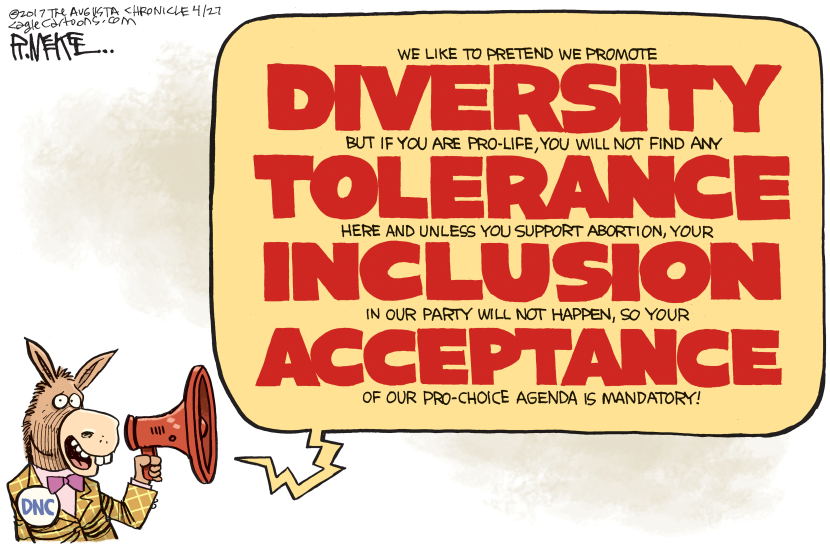
What exactly is this congresswoman calling grotesque?

This month, for the first time in 50 years, the annual March for Life was more celebratory than cautiously hopeful, more forward-looking than burdened by a troublesome history.

Since Roe v. Wade was overturned last June, the pro-life movement has been energized with new possibilities, and this is a reason to rejoice.

However, as we’ve seen from the proponents of abortion rights, who have changed their names over the course of the half-century from pro-choice, to pro-woman, to pro-reproductive-freedom, to pro-reproductive health care, this is a dangerous time as well.

The anger and hysteria that were triggered by the collapse of federal abortion jurisprudence have manifested themselves in violence with the vandalism and firebombing of churches and pro-life clinics, in breathless editorials railing against the Talibanization of American society, and the promotion of legislation at the state level that would expand abortion rights exponentially.

The irony in all of this is that this unhinged reaction to a legitimate exercise of the Supreme Court’s authority — long, long overdue — is exhibited by women who have been elected to positions of authority precisely because they argued that they are reasoned diplomats who can seek consensus where men often fail.

Instead, they look like fools.

Take, for example, the group photo posted by the Democratic Women’s Caucus last week, with a bevy of representatives all decked out in white suits and smiling for the camera like a bunch of middle-aged participants at a college reunion.

The caption to the social media post read: “Our caucus dressed in white today to show our collective resistance to the extreme MAGA Republicans’ anti-abortion agenda. We will always stand up for reproductive freedom and access to abortion care.”

That’s all well and good as far as it goes.

You would expect Democrats, particularly Democratic women, to speak that way about any attempts to limit a “right” that has achieved sacramental status with them.

It’s even understandable that they would have been upset at Republican attempts to pass the Born Alive Act, a bill that mandated medical care for babies that had survived botched abortions.

All of these women had voted against it, preferring to allow the decision to save that struggling human child to remain between the mother who tried to abort it in the first place and her unsuccessful abortionist.

But what I found even more galling than this gruesome vote, was the reaction from my own representative, Mary Gay Scanlon, who was quoted as saying this when asked about her reaction to the bill: “Rep. Mary Scanlon, D-PA, says she opposes the GOP’s ‘grotesque attempt to politicize abortion care and criminalize doctors.’ ”

When I read that quote, I was sure that I was missing something.

There must have been a context that I overlooked because the use of the word “grotesque” in connection with providing life-saving care to a struggling infant seemed so strange as to be improbable.

I hoped that the congresswoman was misquoted. So I emailed her.

“I am writing about Ms. Scanlon’s use of the word ‘grotesque’ to describe pro-life initiatives. Could I please have clarification as to whether the Representative is describing the attempts to save the lives of children in extremis as grotesque? I think we would all benefit from some context.”

I also tried calling her office in Washington and left a message. As of this writing, I did not receive a response. But I wasn’t expecting one, to be honest.

The fact that Scanlon chose the word “grotesque” to define life-saving efforts, instead of using that same word to describe the act that makes those efforts necessary, namely, abortion, is telling.

It’s telling me that the woman who represents me in Congress has no qualms about using extreme language in order to advance the objectives of her pro-choice base.

I can be generous these days. With the fall of Roe and the efforts by many states to drastically limit abortion, if not ban it altogether, the momentum favors the pro-life movement.

To quote the Rolling Stones, time is indeed on my side. Yes, it is.

Nonetheless, I find the PR stunts by American congresswomen to be repellent, since I regularly deal with women who are being persecuted by the actual Taliban in both Afghanistan and Pakistan.

And I wish that my own representative would have had the decency to respond to a request from a constituent who didn’t vote for her, but who asked an honest question.

Still waiting for that answer.

Copyright 2023 Christine Flowers, distributed exclusively by Cagle Cartoons newspaper syndicate.

Christine Flowers is an attorney and a columnist for the Delaware County Daily Times, and can be reached at [email protected].

Comments Off on What exactly is this congresswoman calling grotesque?

Another victim of a ‘small crime’ in a big city

Last week, I was mugged.

It wasn’t as bad as it sounds, because I didn’t suffer any physical injuries beyond a slight bruise to the hip where the two muggers shoved me into the self-service kiosk at CVS. It was one of those classic “push and grab” affairs, where one person distracts you by pretending to accidentally bump into you and the other takes your wallet.

I didn’t make a police report, because I knew it wouldn’t do any good in a city like Philadelphia, where we had more than 500 homicides last year, many of them unsolved. The Philadelphia justice system has more to worry about than Christine Flower’s stolen credit cards.

I was fortunate I didn’t suffer any physical injuries, unlike so many Philadelphians who lost their lives because of policies championed by Democratic District Attorney Larry Krasner.

Krasner and his supporters seem to believe it is a violation of an offender’s civil rights to force them to pay bail, serve appropriate sentences for violent crimes, and be accountable for breaking the law.

The saddest cases are the ones where the DA has completely ignored the pleas of victims and their family members, as he did with the family of Sean Schellenger, who was knifed to death by a man who, today, is living his best life.

Krasner reduced the charges against the killer, Michael White, from first-degree murder to third-degree murder and then again on the eve of trial to voluntary manslaughter. A jury acquitted White of even that charge. At the time of the killing, White was sympathetically described in the media as a promising young man who wanted to write poetry.

Murder is horrific. Rape is evil. Shootings and mayhem make a city unlivable. But so do the smaller crimes that create a sense of unease, of fear, of apprehension. When people feel that they cannot safely walk into a CVS in a relatively placid part of the city, that is the small pebble that creates the larger ripple that creates the tsunami of an exodus.

Rudy Giuliani knew this over 30 years ago. While the former mayor of New York is now the laughingstock of the liberal elites and their friends in the mainstream media, those of us who were alive and visiting the Big Apple in the 1990s understood just how much Giuliani’s “broken windows” theory made sense. It was a recognition that small crimes, like the broken window of a car smashed to grab a radio or other items, created an environment that made people feel as if they lived in an armed camp.

When you prosecute the smaller crimes, you give residents a sense they matter You help them feel as if their lives are more important than the lives of the people preying upon them. In the process, you encourage other people to relocate to the city, repopulating it with productive human beings who don’t make a living as parasites on the sweat of others.

There are a lot of broken windows in Philadelphia. When I take my evening walks, I see the refuse of drug users littering the sidewalks, excrement and castoffs of half-eaten meals. This is the current state of the city of Mayor Jim Kenney, Police Commissioner Danielle Outlaw and the aforementioned Larry Krasner. The lack of concern is manifest.

Currently, there is little reason for me to love this city. But as Pascale wrote, the heart has its reasons that reason knows nothing of.

To me, Philadelphia is the surprise at the end of the Market Frankford El, the magical place I visited as a child with my grandparents. It is the place where I spent Saturdays in the 1960s, with my father and younger brothers. It is the place where I first started practicing law, and where I experienced a Super Bowl, and where I became an adult. It has been the bedrock of my existence for many years. And it hurts to see what someone like Larry Krasner, who cares very little for people like me, who pays her taxes and doesn’t rob others of their hard-earned property, has done to the city.

That’s why I didn’t report the fact that I was a crime victim. There are too many broken windows in this city, too many shrugged shoulders, and too many people in authority who care for the rights of the offenders over the rights of those who simply want to live in peace and prosperity.

In the end, it’s not just the windows that are broken.

Copyright 2023 Christine Flowers, distributed exclusively by Cagle Cartoons newspaper syndicate.

Christine Flowers is an attorney and a columnist for the Delaware County Daily Times, and can be reached at [email protected].

Comments Off on Another victim of a ‘small crime’ in a big city

Are we slowly drifting back into ‘The Twilight Zone’?

When you have the beginning of a cold, nothing sparkly to wear and you really hate New Year’s, you watch television. If a certain station has the good sense to run a marathon of vintage Twilight Zone episodes, your choice is made from the moment you hear “doo dee da doo, doo dee da doo” coming from what you think is your flat screen-but which could, in fact, originate from another planetary system.

So I spent most of the last holiday weekend glued to the portal between reality and fact, science and suggestion, comfort and creeping horror. And I loved it.

I was about 12 when I first viewed “The Eye of the Beholder,” the famous episode where a beautiful woman screams in horror as she realizes that she looks different from everyone else. Everyone else, of course, sport swine-like faces with prominent snouts and hooded eyes. To see her reduced to paroxysms of grief because she doesn’t look like them begs the question: is beauty an absolute, or is it measured in relation to society’s standards?

Another memorable episode was “Walking Distance,” in which Gig Young played a man who was magically transported back to his boyhood home. There was an incredible amount of poignance when an adult confronts his mortality and the unappreciated joys of an unencumbered childhood. Watching the show today, the melancholy of the character melds with the actor’s own personal demons, which led him to take his own life.

There are so many exceptional episodes from the classic series, including several that have become a part of popular culture: “It’s A Good Life,” where a young boy is able to make people who anger him disappear “into the cornfield.” “Nightmare at 20,000 Feet,” where William Shatner sees a demon on the wing of a plane, and can’t convince anyone that he’s not having a mental breakdown. “Deaths Head Revisited” where a former SS officer returns to Dachau and finds himself put on trial by the ghosts of the prisoners he tortured. “The Hitch-Hiker” where Inger Stevens frantically tries to avoid a man she keeps seeing by the side of the road, seeking a ride, only to realize at the end that she has actually died.

As I watched these episodes, completely enthralled for hours on end and forgetting that I was in 2023, an unpleasant sensation began to creep over me. When I saw Billy Mummy order people into oblivion, it reminded me of the MeToo movement, the Black Lives Matter Movement, Twitter, Facebook, the removal of statues and the erasure of murals, and the destruction of lives because someone didn’t like them. Rod Serling’s petulant and vengeful little boy presaged an entire society that could no longer tolerate certain people, certain beliefs, certain traditions or values or moral precepts. And instead of making space for them in the marketplace of ideas, they were sent to the cornfield, where they have disappeared into the windswept stalks of grain.

Watching “Nightmare at 20,000 Feet,” it reminded me that people who are often telling the truth and trying to communicate danger to the rest of us are considered mentally ill, or worse. Parents who have sounded the alarm about the way their adolescent children are allowed to morph into gender fluid creatures, receiving irreversible medical treatment before they are able to reason through their sexual confusion, are called bigots, ignorant, or in some cases, criminal. It’s like William Shatner trying to tell us that there is something there on the plane, and it’s threatening to take us all down with it, and we laugh and call him a fool.

Seeing Inger Stevens in agony as she realizes that her entire life has been lived in service to her parents, people who wanted a “child” to fill their emptiness but who programmed the “perfect” machine, reminded me of the way that people have begun to talk about abortion. Women, who are horrified that Roe v. Wade have been overturned, have begun to use the language that would have fit right into a Twilight Zone episode: “reproductive autonomy,” “bodily integrity,” “my rights,” “unsustainable life,” “anti-choice villains.”

I understand that we live in a world quite different from the one that watched the original Twilight Zone episodes. We accept things now that were unthinkable then, and that’s a function of society. Things, inevitably, change.

But some things manage to remain the same. Our sense of decency, humanity, righteousness, compassion and dignity don’t change simply because the years advance. And watching Rod Serling’s mini masterpieces reminds me that the past is prologue, and we might have been living all along in a world that is slowly drifting into twilight

Copyright 2023 Christine Flowers, distributed exclusively by Cagle Cartoons newspaper syndicate.

Christine Flowers is an attorney and a columnist for the Delaware County Daily Times, and can be reached at [email protected].

Comments Off on Are we slowly drifting back into ‘The Twilight Zone’?

Lying will hurt others and end up hurting the teller, too

As a child, lying was something I rarely did. This was a function of two things: being Catholic and being lazy.

But perhaps the most compelling reason not to lie is that you will always be outed.

It may not happen immediately, but there is simply no way to go through life telling lie after lie without someone eventually figuring out that you did not serve with honor in Vietnam, Sen. Blumenthal, that your version of your wife’s tragic death was not accurate, President Biden, and that you did not go to college, U.S. Rep.-elect George Santos.

The amazing thing, to me, is that high-profile people lie as if the internet didn’t exist. We all have a cyber footprint, and it’s so easy to figure out when someone is fabricating an entire narrative that is more fiction than fact.

James Frey made the mistake of lying to Oprah, who had featured his memoir, “A Million Little Pieces,” in her book club back in 2006.

The author lied, he didn’t just embellish facts, and the queen of television was pissed.

The irony is that it was so easy to establish the falsehoods, particularly since they were published in a book that attracted national attention.

What was Frey thinking? Is it possible that the narcissism that lies at the root of falsehood and betrayal blinds us to the ease of unmasking?

These days you press a button, and google becomes the oracle of truth.

I was thinking about all of this when I watched as Democrats demanded the resignation of Republican George Santos.

Frankly, I’d have no problem if he were forced out of office.

Here is what he lied about: his education, his work history and his property ownership.

He lied about getting a college degree.

He lied about working on Wall Street.

He lied about his taxes.

He lied about his personal life, including marriage to a woman when he now identifies as gay (not that there’s anything wrong with it.)

He lied about a lot of things that matter, and some things that don’t.

While his serial embellishment is not exactly an impeachable offense, it is troubling.

It’s almost as if he created an entirely different person in order to win an election, and that means the voters didn’t actually get what they bargained for.

Bad look for the Republican.

But you know who else I wish we could hold up for ridicule and shame? Richard Blumenthal is at the top of the list.

The Democratic senator from Connecticut did something that this relative of Vietnam veterans can’t forgive: He lied about being in combat.

He didn’t actually say he came “under fire,” but the implication was clear.

During his Senate race in 2010, Blumenthal repeatedly noted that he had “served in Vietnam.” He was never even near Vietnam.

Blumenthal served in a reserve capacity stateside.

That’s still honorable. But it isn’t putting your body on the line in a bloody war.

The way that the media has tried to cover for him, particularly after his lies were underscored by Donald Trump, indicates just how far the mainstream will go to protect the stolen valor of a Democrat.

And speaking of Democrats, there’s President Biden. We all know about the tragedy of his young family.

Growing up just over the Delaware line, I’ve been aware of the loss of Biden’s first wife, Nelia, and his baby daughter, Naomi, in a horrific car crash.

I always assumed that the crash was caused by a drunk driver who blew through a traffic light.

The reason I believed that was because this is how Biden described the incident:

“A tractor-trailer, a guy who allegedly — I never pursued it — drank his lunch instead of eating his lunch, broadsided my family and killed my wife instantly, and killed my daughter instantly.”

Biden knew that the driver had never been charged with drunk driving, was never arrested, was never sued or was held responsible for the accident.

There was evidence that Biden’s wife veered into the truck’s path, not the other way around.

But Biden used the power of his own pulpit to defame a man who had to live a good part of his life with the burden of an onerous lie.

Lies are bad. They degrade the people who tell them and hurt those about whom they are told.

George Santos should be ashamed. But not because he’s a Republican, because he’s a human being who tried to fool us into believing he was better than he really is.

He has a lot of company.

Copyright 2023 Christine Flowers, distributed exclusively by Cagle Cartoons newspaper syndicate.

Christine Flowers is an attorney and a columnist for the Delaware County Daily Times, and can be reached at [email protected].

Comments Off on Lying will hurt others and end up hurting the teller, too

In the darkest moments, the power to bring light

Christmas is my favorite holiday.

Nothing else even comes close.

I don’t think I’m exceptional in this. Most people, unless they have hearts the size of the Grinch’s before he had his Whoville epiphany, would agree that there is nothing more magical than the holiday that celebrates the birth of the Christ child.

You don’t even need to be Christian to appreciate it.

Ironically, the most memorable Christmas holidays in my 61 years have been experienced in the shadow of sadness, which made them all the more poignant and taught me lessons in humility and gratitude.

My first holiday encounter with the true meaning — and unexpected reality — of Christmas was the one in 1965, three weeks to the day after I’d celebrated my 4th birthday.

There I was, sitting with my mother and father, ripping into what I can only imagine were delightful presents, when my father announced that “Mommy and Daddy are taking you to Mom Mom and Pop Pop’s house.”

Not completely understanding the necessity to abandon my own personal party, I am told that there was definite pushback from the mouthy 4-year-old. But Mom had gone into labor with my baby brother, who would be born later that day.

That Christmas, memorable as it was for my mother who apparently had a visit from the angel Gabriel on the same exact date as Mary, was a letdown.

From new life to the shadow of departure: On Dec. 11, 1968, just three years later, one of those two beloved grandparents passed away.

My grandfather Mike had been a heavy smoker, and the only vice he had in what was an otherwise sainted life — unfiltered Chesterfields — took him away from us at the unbearably young age of 58.

I remember my mother telling me years later that as he was lying in the hospital bed, he reached out for grandmom Mamie’s hand and tried to sing “I’ll Be Home For Christmas.”

He couldn’t keep that promise and passed away two weeks shy of her favorite holiday.

I was only 7 and don’t remember the funeral, but I know the toll it took on my mother, six months pregnant with her fourth child, who she would name Michael.

For many years afterward, mom would make sure to bake the pumpkin pie that my grandfather coveted, a special Christmas tradition because it was a visceral connection to the first man she had ever loved.

I’ve always believed that there is a strange symmetry in life, and life has not disappointed me.

My grandfather was born on a Nov. 7, and died on a Dec. 11. His wife, my beloved Mamie, was born on a Nov. 8 and died, in 1985, on Dec. 12.

These two people who were joined by love and duty lived in synchrony and died with the same exquisite unity.

I was studying for law school finals when the word came that my Mom Mom had suffered a massive heart attack as my mother — her firstborn — was driving her to the hospital for a check-up.

There were three generations of women in the waiting room, hoping for a miracle. It never came, and Mamie Fusco went home to be with her Mike.

I remember taking in the Christmas tree, and the festive decorations and wondering how the world could keep turning when the center had fallen out of it.

There was another Christmas, one that I spent thousands of miles away from my family, separated by an ocean and five time zones.

It was 1981, and I was spending my junior year abroad in Paris. My father had been diagnosed with cancer that May, and I balked at going away for so long.

But my father refused to have me miss this opportunity and promised that if I left as planned that September, they’d let me come home for the holidays.

I believed him. But as December approached, I got a message from my mother telling me that they’d decided to let me experience a once-in-a-lifetime adventure.

Without my knowledge, they’d contacted old friends of my father who lived in Canterbury, England, and asked them if I could stay with them over Christmas.

I was having none of it, complained, cried and tried to guilt them into having me home. But the die had been cast: It was Canterbury, not Havertown for me.

It was only later that I learned why the plans had changed.

My father had taken a turn for the worse, and the cancer had spread. None of the protocols and treatments were working anymore, and he was going to be in the hospital over Christmas.

My parents were trying to save me from having to deal with a bitter truth: This would be the last Christmas together. They wanted to give me a holiday unencumbered by grief.

I did not know it at the time, but they had given me the greatest gift I’ve ever received.

Christmas is magical. But I think that we sense its true meaning, its most infinite glory, not in times of comfort, but in difficulty.

In the darkest moments, it has the power to bring light.

Copyright 2022 Christine Flowers, distributed exclusively by Cagle Cartoons newspaper syndicate.

Christine Flowers is an attorney and a columnist for the Delaware County Daily Times, and can be reached at [email protected].

Comments Off on In the darkest moments, the power to bring light

Kirstie Alley’s passing unleashed the left’s dark side

I turned 61 last week.

I don’t plan on joining the celestial choir any time soon, but birthdays make me think of the opposite end of the life cycle.

Every birthday morning, I have a somewhat ghoulish tradition of writing a mental obituary, composing my own epitaph since I don’t trust others to pen it for me.

We all should prepare our own “homegoings,” as my friends in the African American community call it, because there’s been a troubling trend toward speaking ill of the dead. If you can get your story out before the haters have their say, you’ve won the eternal battle.

This was brought home to me when I read the cruel things that were written about Kirstie Alley, who died last week from late-diagnosed cancer.

While she most recently sported blonde hair, most of us will remember her as the breathtakingly beautiful woman with the raven locks who replaced Diane in Sam’s affections on “Cheers.”

The character of Rebecca was the opposite of Shelly Long’s annoying and cerebral dilettante, filled with fire and fury and fun. She was a perfect replacement for Diane, even though the dynamic between her and Sam was completely different.

And while Long’s sort of humor was more along the lines of a sophisticated-but-neurotic Myrna Loy, Alley was the reincarnation of Lucille Ball with her physicality and willingness to look silly.

Alley appeared in many other roles, but she’ll always be remembered as Rebecca.

She was also a high-profile Scientologist. Up until recently, that was the only controversial aspect of this beloved comedian.

Then came Twitter, and Alley began to express political views that shocked the sort of fan who thought she walked in lockstep with their progressive outlook.

More importantly, she didn’t seem to hate Donald Trump. In fact, in some tweets, she endorsed his policies.

The Scientology thing was OK, even though it made some people squeamish because of the rather strange beliefs on psychotherapy (evil!) and ex-Scientologists (evil!).

Kirstie’s public battles with her weight were also endearing, because who doesn’t love someone who is honest about their personal struggles?

But when it became clear that Kirstie was a conservative, and possibly a Trumper, the dogs of war were unleashed.

I would follow her Twitter feed and see people write the most amazingly cruel things, acting as if she’d just declared her loyalty to ISIS.

People started showing, with pride, screenshots of being blocked by the actress as proof that she was a MAGA crazy who couldn’t take criticism.

When you delved a little more deeply, you understood why she’d canceled these folks: they were absolutely horrible in their attacks.

In some bizarre turn of events, the progressives felt betrayed by their beloved.

The breakup was ugly.

But the worst part came after her death was announced.

Mixed in with the many expressions of sympathy and sorrow were a large number of sarcastic digs about how Scientologists don’t think they can get cancer, and now isn’t she surprised?

They also dismissed her as a “Donald Trump Apologist” with her Wikipedia page immediately edited by some low-life hacker to read “Conspiracy Theorist Nut Job.”

This was only moments after her death had been announced by her grieving children.

I have to admit that I’m particularly outraged because I’ve seen the cruelty of the left much more often than I care to remember. In my own life, people I love have been targeted as proxies, and my inbox has filled with the most disgusting vitriol over the years.

I’m a very, very, very minor media figure. Most people have no idea who I am beyond “that crazy lady in Philadelphia who sort of looks like Sarah Palin.”

I can only imagine the things real celebrities like the aforesaid Palin are subjected to.

But this isn’t about left or right, to be honest.

This is about human decency.

When a person dies, unless they’ve left a truly toxic mark on society, their passing should be either noted with respect or ignored. Hatred has no place in epitaphs.

I am sure that some on the right are as guilty of this vice as the legions on the left.

I wrote about the phenomenon when John McCain passed away and condemned the partisan attacks from right-wing extremists. It is a shared inhuman flaw.

The point is that when someone ascends to whatever Heaven awaits, or descends to whatever depths he deserves, we should note that passing with grace, kindness, and a factotum of regret.

And if we cannot, we need to shut up and hide the demons consuming us from within.

Copyright 2022 Christine Flowers, distributed exclusively by Cagle Cartoons newspaper syndicate.

Christine Flowers is an attorney and a columnist for the Delaware County Daily Times, and can be reached at [email protected].

Comments Off on Kirstie Alley’s passing unleashed the left’s dark side

Terrible that children are pawns in gender fluidity movement

Our birth is but a sleep and a forgetting / The Soul that rises with us, our life’s Star / Hath had elsewhere its setting / And cometh from afar / Not in entire forgetfulness / And not in utter nakedness / But trailing clouds of glory do we come.

— William Wordsworth, “Ode: Intimations on Immortality”

When I first read this poem in 11th grade, I was profoundly touched by the imagery it evoked.

I was already pro-life at that point, but it seemed as if Wordsworth were telling me that life is a continuum that circulates between the heavens and this Earth.

This column is not about abortion. But it is about children, and what they mean to us in a society that pretends to care about their needs but really only cares about our own.

Years ago, I wrote about the controversy involving the Boy Scouts in Philadelphia, and the city’s attempt to evict them from a building they had built and occupied for almost a century.

The reason for the threatened eviction was a Boy Scout policy not to allow openly gay scouts or scoutmasters into the organization. There actually wasn’t a policy, it was simply understood that sexuality should not be an issue when trying to teach 8-year-old boys how to tie square knots and win merit badges.

As it turns out, the Scouts sued, and won in federal court, because it became a First Amendment issue and the city was trampling on the Boy Scouts’ right to freely assemble and associate.

Sadly, the crusade to exploit children continued. In fact, it’s become more vicious and more toxic almost 20 years later.

There is the push for Drag Queen Story Hour, which is nothing more than an attempt to normalize what we used to call “transvestism” and would now fall under the large umbrella of “gender fluidity.”

I’ve also written about libraries that warmly invite men in spangles and spandex to come and read fairy tales — pun not intended but unavoidable — to toddlers.

In defense of the program, progressive activists and the mommies who date them say that it’s all about fantasy. They don’t talk about sex and it’s a lovely opportunity for children to hear classic stories told to them by wonderful actors.

When you reply: “Why do those actors have to be impersonating Dolly Parton,” they don’t have an answer, other than to call you a bigot.

If wanting to keep children suspended in wonder and the purity of childhood amounts to bigotry, then sign me up.

But I’d even concede that although it is troubling to expose kids to drag queens who make questionable fashion choices — because, after all, they’re drag queens — it is far worse to exploit them in advertisements that depict sadomasochism as a legitimate form of interpersonal communication.

Balenciaga recently ran an ad campaign with photos of kindergarten-aged children positioned front and center in scenes that would make a porn star blush. There were images of bondage, of brutality, of blood and sexual perversion, mixed in with wide-eyed innocence and teddy bears.

It is sick, and it is vile, and it is an outgrowth of society’s refusal to recognize that evil and immorality exist.

The moral relativism of “tolerance” has bled into the idea that what consenting adults do in their own bedrooms is no one else’s business.

Guess what? When that consensual activity becomes part of a societal transcript for what is cool and acceptable, it is our business.

That’s because it helps coarsen discourse, which inevitably blunts our ability to recognize perversity, makes us unwilling to be called bigots and prudes, and threatens our children.

There is nothing more despicable than adults who care more about their credibility with the woke than the welfare of their children.

This is why the whole gender fluidity movement has achieved respectability. Like the fable “The Emperor’s New Clothes,” there are some people who are afraid to point out the obvious: there are two biological sexes, and two genders and all the rest is psychological confusion.

The studies and the so-called clinical research into how a girl can actually be born in the body of a boy is nice cover for a social crusade to blur the lines and give us complete autonomy over our identity.

While I find it bizarre and toxic, adults are free to do what they want, and I am free to give those adults the widest berth.

But they have no right to use children in their diabolical attempts to erase reality.

Children are not property.

We are the custodians of their glory, guardians of their welfare, and bystanders to their wonder.

Our only obligation is not to destroy, with our own narcissism, that miracle.

Copyright 2022 Christine Flowers, distributed exclusively by Cagle Cartoons newspaper syndicate.

Christine Flowers is an attorney and a columnist for the Delaware County Daily Times, and can be reached at [email protected].

Comments Off on Terrible that children are pawns in gender fluidity movement

Predictable progressive response after gay club shooting backfires

Following the tragic shooting at an LGBTQ nightclub in Colorado Springs, it was predictable that along with the gun control discussions, the conversation would bleed out to include “hate speech.” It was also predictable that only conservatives would be blamed for that speech.

I understand the argument that going after someone because of their identity is an aggravating factor, and I even agree that it should be considered in sentencing. Having practiced immigration law for so many years, and specializing in asylum, I not only accept but vigorously defend the right of people to be protected against abuse on account of their race, religion, national origin, sexuality, politics or any other increment of their identity.

But even if I thought that it was helpful to graft an additional requirement onto the penal code, namely that some victims are more worthy than others (translation: Anyone but white Christian heterosexual cisgender males) laws against hate speech would never pass constitutional muster.

That’s also why I have a huge problem with the suggestion that opposing same sex marriage and, in the case of legislators, voting against legislation that would codify it and overturn the Defense of Marriage Act makes you a killer.

It’s not enough for those on the left to call their opponents bigots. They also have to make those on the right responsible for the bloody body count. Sadly, that seems to have boomeranged against them spectacularly in this case.

The Colorado shooter’s attorney announced that his client identifies as non-binary, and wants us to use the pronouns “they/them.”

The left reacted like deer in headlights, now that their preferred narrative was shattered.

If they accept that the shooter is a member of the LGBT community, they can’t blame Republican hate speech. If they say he’s just pretending to be non-binary as a legal defense, they are rejecting their central theory that everyone gets to define their own identity.

And this is the dilemma that hate speech leads us to.

On social media, I’m attacked and vilified with all sorts of slurs and comments I will not reproduce verbatim here. None are legally defamatory or  particularly galling, given my decades on the front line of hateful rhetoric.

And none of them were likely to incite someone to shoot me dead, even though they had a dehumanizing aspect. I would not accuse the people using this language of putting my life in danger.

As an aside, let me say that I have never been slandered by conservative men, and have found that males who self-identify as feminists have an impressive level of tolerance for misogyny against conservative women.

You only have to see the type of vitriol aimed at Lauren Boebert, Marjorie Taylor Greene, Sarah Palin, Michelle Bachman, Sarah Huckabee Sanders, Kellyanne Conway, Meghan McCain and every current and former female at Fox News not named Gretchen Carlson to see that name-calling is fine as long as the target is not a member of the favored political tribe.

And guess what? That’s OK. We’re all big girls.

None of us is whining about how the hatred is driving us to the edge of the ledge in our Jimmy Choos.

Which brings me back to my central point. When progressives try to blame every bad thing that happens against a minority on conservatives, they don’t need motive or weapons.

They weaponize words, which is the easiest way to gaslight the gullible into thinking that the pen is, to paraphrase Teddy Roosevelt, deadlier than the sword.

That’s foolish, insulting and un-American. Words can inspire, and they can anger. They can defame, and they can honor.

They can create countries, rend them asunder, and stitch the ragged edges together again.

What they cannot do is kill. And no amount of whining, scapegoating and passive aggressive lamentation over the dead bodies of real people can change that fact.

Those who even try, are shameful creatures.

I have choice words for them, but I don’t want to be accused of committing a felony.

Copyright 2022 Christine Flowers, distributed exclusively by Cagle Cartoons newspaper syndicate.

Christine Flowers is an attorney and a columnist for the Delaware County Daily Times, and can be reached at [email protected].

Comments Off on Predictable progressive response after gay club shooting backfires

Three pillars of progressive philosophy revealed

In the smoldering wake of what can only be called a Republican debacle, many pundits much better schooled in politics and history weighed in with their opinions on what happened.

But in the days after the election, one which dragged on interminably and unforgivably due to GOP negligence and Democratic exploitation, a few things became clear to me. Here they are, in no particular order.

Progressives want things, and they don’t want to pay for them.

Conservatives want things too, but we manage to muster a bit of shame about our desire for acquisition. Progressives have no such reservations, and tell us in an almost admirably direct way what they deserve.

Take women. My liberal sisters believe that they have the right to have an abortion whenever and wherever the spirit moves them. They might give lip service to the concept of exceptions, but when you do suggest limitations as Lindsey Graham did with his 15 week ban, they balk.

Conservatives might be squeamish about drawing bright lines dissecting the period between “no abortion,” “some abortion,” and “go ahead have an abortion with a side of fries,” but we generally accept that dominion over life and death is not something that should be left to a mother and her obstetrician.

But we don’t even have to get to the life and death issues to see how differently the left wing and the right deal with the world.

I attended a forum the other evening featuring a mayoral hopeful in Philadelphia named Helen Gym, a well-known city councilwoman some say is the leading candidate to win the race next year. But Gym gave a progressive tell when someone asked her about the problems with trash collection.

Gym stated that it was an issue of “equity.” I leaned in to hear how she was going to tie garbage to the civil rights movement. She did not disappoint.

The councilwoman said that she had recently been to an elementary school graduation, and lamented that the kids and their parents, dressed so beautifully, had to walk by piles of trash that the city hadn’t yet picked up. She suggested that in some neighborhoods, it was important to have twice weekly pick ups, whereas in others, once a week was sufficient. That, she said, was equity.

I was astounded. My grandmother, who left school in third grade and was poor most of her life, made it a point to scrub down the pavement in front of her West Philadelphia row home every couple of days. Her husband, my Pop Pop, was a trash collector for the city of Philadelphia for many years, until he fell off of a truck and broke his back.

Poor people can pick up after themselves if they have a modicum of dignity. But the councilwoman was suggesting that if you live in certain depressed and minority neighborhoods, you need the government to hold your hand.

Progressives never think people are capable of autonomy, and the village must always rush in to help.

Another development that underlined the difference between liberal and conservative philosophy was the news this week that the Pennsylvania House had voted to impeach Philadelphia’s District Attorney, Larry Krasner.

It’s as yet uncertain whether a trial will be held in the Senate since it’s a lame duck session and they’ve adjourned for the year, but the mere fact that legislators — admittedly all Republicans — agreed to at least symbolically hold the criminally negligent prosecutor accountable for the rising homicide rate was great news.

It also reminded me once again of John Fetterman, our senator-elect, who was once on the Pennsylvania Board of Paroles and regularly cast the only vote to release on early parole violent criminals. In one case, he was in favor of commuting the sentence of a man involved in the murder of my friend’s father, a beloved neighborhood pharmacist in Overbrook.

Who is going to give the murder victim’s grieving survivors a new chance at waking up in the morning, free from the psychological and emotional pain that will follow them through the rest of their lives?

Not John Fetterman. Not the sort of people who say “he paid his debt to society.”

Frankly, if you take a life, the only way to pay that debt is to surrender your own. And if the death penalty makes you cringe, life imprisonment with no parole is the answer.

These things: abortion, a desire for unlimited government aid, and a refusal to recognize the pain of victims define for me the philosophy of the progressives.

The fact that this philosophy was embraced by so many this month makes me infinitely sad.

It also makes me determined to rage against the dying of the light, and fight against abortion rights, fight for the rights of victims.

And, oh yeah, pick up my own trash.

Copyright 2022 Christine Flowers, distributed exclusively by Cagle Cartoons newspaper syndicate.

Christine Flowers is an attorney and a columnist for the Delaware County Daily Times, and can be reached at [email protected].

Comments Off on Three pillars of progressive philosophy revealed